
5 Best Golf Cart GPS Tracking Devices (Theft-Proof Picks)

Key takeaways
5 things to know before tracking a golf cart
-
01
A magnetic tracker fits a cart in seconds and moves between them just as fast
-
02
Update rate decides recovery, because a minute is a long way at speed
-
03
Geofence the property and you hear the moment a cart crosses the line
-
04
No cellular tracker is free forever, so compare the plan and not the sticker
-
05
A kill switch and a tracker together beat either one on its own
Protecting a cart or a whole fleet?
Magnetic trackers, 3-second updates, free lifetime USA-based support.
As an Amazon Associate we earn from qualifying purchases.
Golf carts are unusually easy to steal. There is no ignition key worth the name, and a cart weighs little enough to winch onto a trailer. Most sit outdoors overnight, somewhere anyone can drive to.
The good news is that carts are also easy to track. They are metal, so a magnet holds, and they rarely leave a fixed property, which is what makes geofencing work. Below are five trackers that suit the job, and the honest limits of each.
Quick Comparison
Swipe or scroll the table sideways to compare all five trackers.
| Tracker | 
|

|

|

|

|
|---|---|---|---|---|---|
| Update rate | As fast as 3 seconds | 60 seconds by default | As fast as 5 seconds | 3 seconds on the top tier only | On movement, not continuous |
| Battery | 1 to 3 weeks live | Up to 60 days, per the maker | Up to 14 days at 60-second reporting | 7 to 14 days | Up to 6 months, non-rechargeable cells |
| Best for | Courses and private carts alike | Large fleets on a tight budget | Quick response to a theft | Carts left out in bad weather | A single cart left at home |
| Buy | Buy Now | Amazon | Amazon | Amazon | Amazon |
How We Picked These
Rankings rest on three things: published specifications, our hands-on time with several of these units, and what buyers report afterwards. Several of the trackers here sit in our own test collection. Every photo below is ours rather than stock.

1. SpaceHawk: Best GPS Tracker For Golf Carts

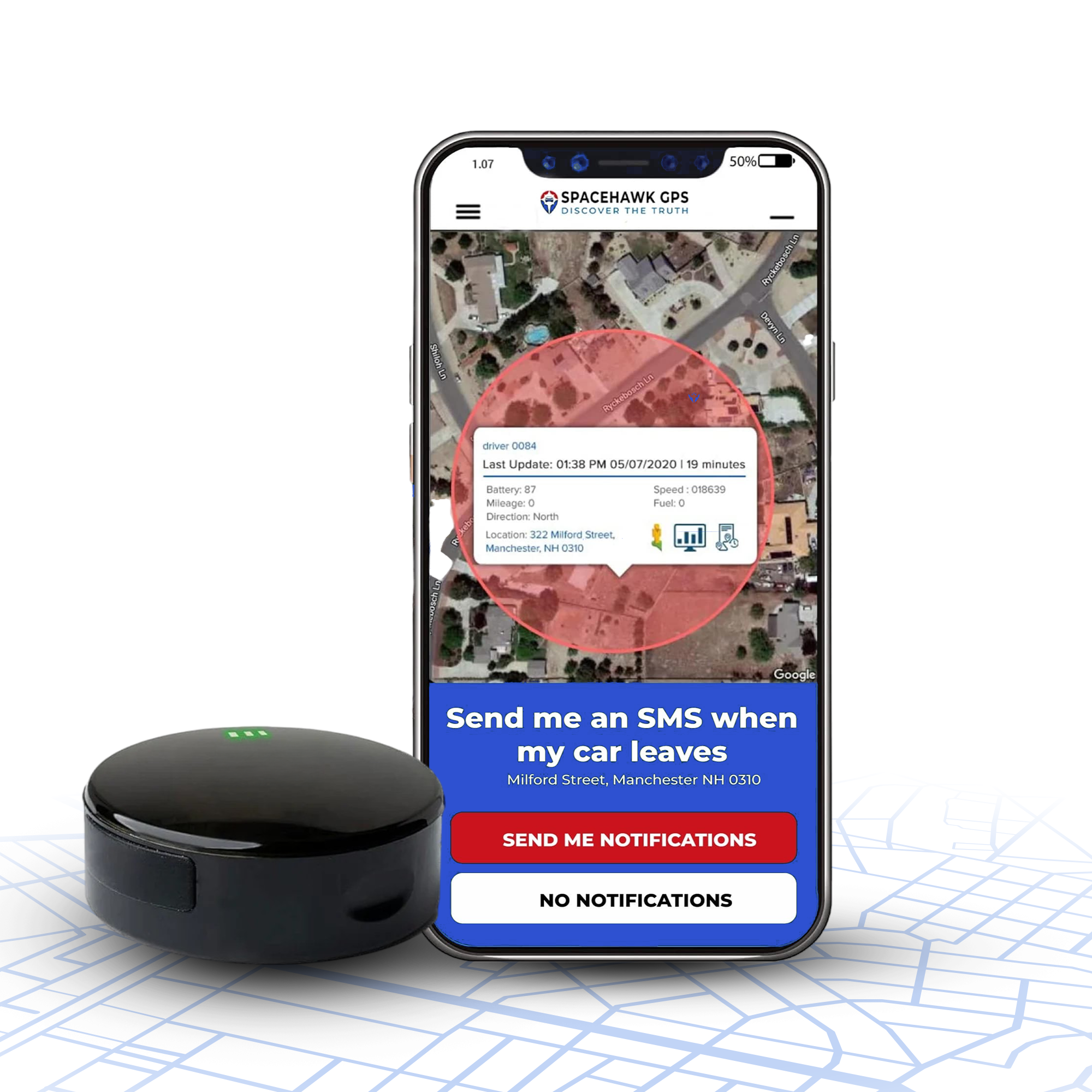
A golf cart is a frame of bare metal, which is the best possible surface for a magnetic tracker. SpaceHawk measures 2.275 inches across and goes on in seconds with no wiring. Removal is just as fast when a cart is sold or swapped.
Updates run as fast as every 3 seconds, with accuracy around 6 feet. A full year of history lets you check where any cart was on a given afternoon.
The housing is waterproof, which matters on a vehicle with no doors.
Battery runs 1 to 3 weeks in live mode and stretches to months in low power. On a fleet, that is a charging round every few weeks rather than every few days.
Key features
- Updates as fast as every 3 seconds
- Accuracy around 6 feet
- Waterproof housing, built-in magnet
- One full year of location history
- Geofence and movement alerts
- Lifetime warranty and USA support
Pros and cons
Pros
- Fastest updates here
- Fits in seconds
- No wiring needed
- A year of history
Cons
- Needs recharging
- Plan billed monthly
- Magnet needs steel

2. Tracki: Cheapest Way To Cover A Fleet

Tracki is the volume seller in this category, and the device price is genuinely low. The unit is small, magnetic and waterproof, with a worldwide SIM in the box.
Two things to know before buying a dozen. Default reporting is every 60 seconds, and faster intervals cost more. The low sticker price is also a subscription model. The meaningful comparison is the monthly figure across a fleet, not the device.
Device prices on this listing move often. Check the current figure rather than trusting any article, this one included.
Pros and cons
Pros
- Low device cost
- Small and magnetic
- Worldwide SIM included
Cons
- 60-second default reporting
- Faster updates cost extra
Why 60 seconds is the wrong number for a stolen cart
Carts top out around 15 to 25 mph. A minute between reports puts a quarter mile between where the cart is and where your phone says it is.
On a trailer behind a truck, that same minute is a mile. Fast reporting is the difference between following a cart and searching for one. Update rate therefore outranks almost everything else here.
3. Spytec GL300: Fastest Reporting Among The Rivals

Worth knowing before you compare quotes: Atlas and GL300 are the same product. Atlas is the marketing name and GL300 the model number. The tracker runs through the Hapn app, since Spytec moved off its own platform.
Reporting goes as fast as every 5 seconds, and battery runs up to 14 days at 60-second intervals. Run it fast and that figure drops sharply, which is the trade every battery tracker makes.
One limit that matters on a golf cart. Atlas is rated IPX5, covering rain and spray but not submersion. Despite a reputation for toughness, the Atlas is the least sealed unit here.
Pros and cons
Pros
- 5-second reporting available
- Long track record
- Geofencing and history
Cons
- IPX5 only, no submersion
- Priciest plan on this page
4. LandAirSea 54: Best Sealing For Carts Left Outside

The 54 carries an IP67 rating and the strongest built-in magnet in this group. The combination is exactly what a cart living outdoors year round needs. Battery averages 7 to 14 days with motion-activated sleep, and history runs a full year.
Correct the headline before you budget. The 3-second update rate belongs to the premium SilverCloud tier, not the entry plan. The unit also requires a subscription, whatever a listing implies about no monthly fees.
Accuracy sits around 8 feet, made in the USA, with an unconditional lifetime warranty.
Pros and cons
Pros
- IP67 sealed, with the strongest magnet here
- Lifetime warranty
Cons
- 3 seconds is top tier only
- Subscription required
5. Monimoto 7: An Alarm That Happens To Track

Monimoto works differently to everything else here, and the difference is the point. The unit pairs with a key fob and stays asleep. If the cart moves while the fob is elsewhere, your phone rings.
A phone call beats a notification at 3am. The non-rechargeable cells run up to six months, because the unit spends most of its life dormant.
The trade-off is that it is an alarm first and a tracker second. There is no continuous live view. The fob also has to travel with the authorized driver, or every legitimate trip raises an alert.
Pros and cons
Pros
- Calls rather than notifies
- Months between batteries
- Nothing to wire in
Cons
- No continuous live view
- Depends on carrying a fob
3 vs 60
Seconds between reports on our top pick against the budget default, a quarter mile of difference at cart speed
This one spec decides whether you follow a stolen cart or go looking for it.
What To Look For In A Golf Cart Tracker
Five features carry most of the value, and a couple of them get overlooked.
Reporting interval
Three seconds draws a line you can follow. Sixty draws dots you have to guess between, and the gap widens as the cart speeds up.
Geofencing
Draw a boundary around the property and the alert fires as a cart crosses it. At a fixed site like a course, this is the feature that earns its keep.
A real magnet
Carts are steel underneath, so a strong magnet fits in seconds and moves between carts as the fleet changes. No wiring, no downtime.
Weather sealing
A cart has no doors and often no cover. IP67 or a properly waterproof housing is not optional if the fleet sits out through winter.
A year of history
Route history answers questions after the fact. Which cart went where, how long it sat, and who had it out when something got damaged.
The plan, not the device
Multiply the monthly figure by the number of carts and by three years. That total, not the sticker price, is what a fleet actually costs.
A tracker that clears all six is rare, which is why the table above ranks trade-offs rather than perfection.
Kitting out a whole fleet?
Tell us how many carts you run and where they sit overnight. We will come back with cost per cart per year, volume pricing, and a free tracker to test on your own fleet first. Learn firsthand why SpaceHawk is the best GPS tracker for golf courses. Call 855-922-8100.
Ask us"Nobody budgets for a stolen cart until the morning one is missing. Fifteen years in, the pattern is simple. Tracked carts come home and untracked carts become insurance paperwork."
Ryan Horban
GPS Tracking Expert, GPS Tracker Shop
Layering A Tracker With Other Deterrents
A tracker recovers a cart, but it does not stop the theft. The sensible setup pairs it with something that does.
Lighting and cameras
Motion lighting over a cart barn changes the calculation for anyone weighing an easy target. Footage is far more usable when the area is lit.
A kill switch
A hidden switch cuts the circuit so the cart will not move even with a key. Our hardwired tracker with kill switch combines both jobs.
Physical locks
A wheel clamp or a chain through the frame turns a two-minute theft into a noisy fifteen-minute one. Most opportunists move on well before that.
Stack two of the three with a tracker and a cart stops being the easy target on the street.
Final Thoughts
A golf cart is one of the easiest vehicles to steal, and one of the easiest to protect. The frame is bare steel and the property is fixed. A magnetic tracker with a geofence covers both weaknesses in one fitting.
Match the tracker to the job. SpaceHawk suits most carts and every course, while Tracki stretches a tight fleet budget. The GL300 answers fastest of the rest, the 54 shrugs off weather, and Monimoto guards a single cart at home.
Whichever you pick, work the plan cost across three years before you commit. Pair the tracker with a lock or a kill switch as well. One gets the cart back. The other keeps it from leaving.
Sources
- SpaceHawk specifications and data plans, GPS Tracker Shop
- Manufacturer specifications and current retail listings for each product named.
Tracking one cart or a hundred?
Tell us the fleet size and where the carts sit overnight, and we will price it per cart. Free USA-based support for the life of every device we sell.
About the Author

Frequently Asked Questions
Is GPS tracking worth it for a golf course fleet?
Can GPS tracking help with pace of play?
Where should the tracker go on a golf cart?
Do I need a subscription for a golf cart tracker?
Can you put a GPS tracker on a golf cart?
What is the best way to protect a golf cart from theft?
- Choosing a selection results in a full page refresh.
- Opens in a new window.
 Buy on Amazon