
How To Secretly Track a Vehicle

Key takeaways
5 things to know before tracking a vehicle
-
01
Ownership decides everything, so start with whose vehicle it is
-
02
A dedicated tracker is the only option built for the job, from $39.95
-
03
A spare phone in the glovebox works, badly, and costs nothing to try
-
04
Built-in connected services only exist on some vehicles, so check yours
-
05
Only police can trace a vehicle from a license plate, never a member of the public
Tracking a vehicle you own?
Live location, geofence alerts and free lifetime USA-based support.
There are five practical ways to know where a vehicle is. They differ enormously in cost and reliability. One is free if you have a spare phone in a drawer.
All five assume the same thing: that the vehicle is yours, your family's or your company's. Ownership is what makes any of this lawful, and there is a section on it further down.
Here are the five, what each actually gives you, and where each one falls down.
The Five Methods At A Glance
| Method | Cost | Reliability | Best for |
|---|---|---|---|
| Dedicated GPS tracker | From $39.95 plus a data plan | High. Built for the job | Your own car, a teen driver, a trailer |
| Spare phone | Free, if you have one spare | Low. Dies in a day, no alerts | A one-off, short-term check |
| Private investigator | Roughly $100 an hour | High, and documented by a person | Evidence for a legal matter |
| Built-in connected services | Free, or a subscription after a trial | Good, where the car supports it | A late-model car you already own |
| Fleet tracking system | Per vehicle, per month | High, and built for scale | Company vehicles under a written policy |
1. A Dedicated GPS Tracker
Start here, because this is the only method on the list built for the job. Everything else is a workaround that happens to report a location.

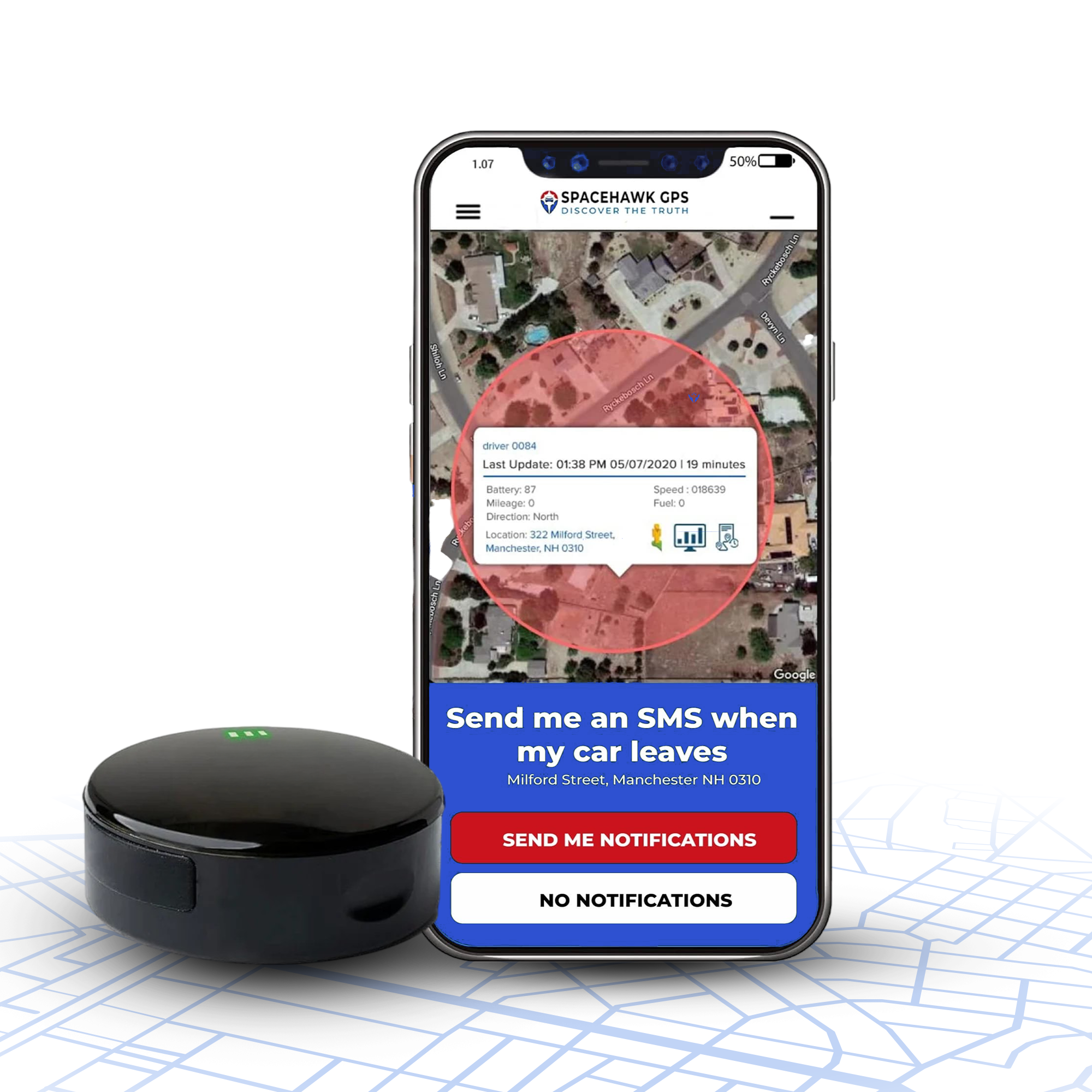
SpaceHawk is a magnetic unit measuring 2.275 inches across, with a waterproof housing. It goes on a flat metal surface in seconds, with no wiring and no port to occupy. Moving it to another vehicle takes just as long.
Updates run as fast as every 3 seconds, with accuracy around 6 feet and a full year of history. Live tracking gives 1 to 3 weeks per charge, and low power mode stretches that to months.
Fit it openly if somebody else drives the vehicle. Somebody who knows the car reports its speed drives differently, which is the point. A device found by accident costs more trust than the data is worth.
What a tracker adds is not really the location. The value is everything that happens without you looking.
Geofencing
Draw a boundary around a yard, a jobsite or a school. Your phone hears about it the moment the vehicle crosses that line.
Movement alerts
A parked trailer that starts moving at 2am sends a notification. Movement alerts are what recover vehicles.
A year of history
Route playback settles questions about where a vehicle was on a given day, which matters for insurance and disputes.
659,880
Vehicles stolen in the United States in 2025, down 23 percent on the previous year
National Insurance Crime Bureau. Falling, and still roughly 1,800 a day.
2. A Spare Phone In The Vehicle
The free option, if a dedicated unit is more than the job needs. An old handset with a working SIM does it for a while, using its own location sharing.
- Set up location sharingUse the phone's built-in feature. Find My on an iPhone, Find Hub on Android. Sign in with an account you control and share the location with your everyday phone.
- Charge it and silence itSilence notifications so a call cannot give it away in a quiet car. Start from a full battery.
- Put it somewhere it will stayThe glovebox or under a seat. Wedge it so it does not slide around and end up under a pedal.
- Check from your own phoneOpen the sharing app and the handset's position is the vehicle's position, give or take.
Why this stops working by tomorrow
A phone reporting its location constantly lasts under a day. There are no geofences, no movement alerts and no history worth reading. You know where the car is at the moment you look, and no more.
Fine for a single afternoon. Useless the week your trailer disappears, which is exactly the week you needed it.
3. A Private Investigator
The old-fashioned route, and still the right one for a narrow set of cases.
A licensed investigator follows the vehicle and documents where it goes, in a form built to survive scrutiny. This matters when the destination is a courtroom rather than your own peace of mind. Custody matters, fraud claims and business due diligence all qualify.
Expect somewhere around $100 an hour, which is why this suits a defined question rather than ongoing monitoring. Be clear on what an investigator can lawfully do, too. They can observe and record movements in public. They cannot record private conversations, and any firm promising that is describing something illegal.
4. Your Car's Built-In Connected Services
If the car is late-model, the tracking may already be paid for.
Most manufacturers now offer a connected-services app with vehicle location. Manufacturers usually give a free trial, then charge a subscription. Coverage is not universal, though. Availability depends on the make, the model year and the trim. Plenty of cars have satellite navigation and no remote location feature at all.
Check the manufacturer's app for your make before assuming. Where the car supports it, this is the cheapest reliable option going. The hardware is already fitted and already powered.
Not sure which method fits?
Tell us the vehicle and what you need to know about it. Call 855-922-8100 and we will point you at the cheapest thing that works.
Ask usThe limitation nobody mentions
Built-in systems draw power from the vehicle, which is a strength until a thief disconnects the battery. They are also documented, so somebody who knows the car knows the service exists.
A battery unit hidden separately is the reason people fit both. The connected service handles convenience, the tracker handles recovery.
5. A Commercial Fleet Tracking System
For a business running several vehicles, per-vehicle hardware plus a management platform is the category built for the job.
Fleet systems add what a single tracker does not. Multiple vehicles on one map. Driver assignment, a full day of route history, and reporting for an accountant. Hardware can be plugged into the OBD2 port or hardwired for good.
The obligation that comes with it is a written policy. Requirements vary by state. New Jersey is currently the only one with a notice statute written specifically about vehicle tracking. Ontario requires a written electronic monitoring policy from employers with 25 or more staff, which matters for cross-border operators.
One approach works everywhere. Track vehicles the business owns, put the policy in writing, and tell drivers before the device goes on.

What The Law Actually Says
Two questions, and they get blurred together constantly.
The first is ownership. Own the vehicle outright, or jointly with a spouse, and tracking it is generally lawful. If you do not own it, fitting a device without the owner's consent is a crime in many states.
The second is notice. Owning a vehicle does not settle what you owe the person driving it. For an employee that means a written policy. For an adult family member driving a car in your name, it means a conversation, whatever the title says.
Before you fit anything, check which of these you are
You own it outright, or jointly with a spouse, or your company owns it. Everything below applies, and for a company vehicle you still need a written policy and drivers told.
Somebody else owns it. Nothing below applies, whatever the relationship. Tracking a partner, an ex-partner or an adult relative's own car stops being a technology question.
Worried somebody is tracking YOU? Different article: how to find a tracker on your car. The National Domestic Violence Hotline is 1-800-799-7233.
Rules vary widely between states, so check yours before buying anything: GPS tracking laws by state.
General information only, not legal advice. The law here turns on case-specific facts and differs by jurisdiction. Consult an attorney about any particular situation.
"The technology question is easy and it is the second question. The first one is whose vehicle it is, and if that answer is complicated, no tracker fixes it."
Ryan Horban
GPS Tracking Expert, GPS Tracker Shop
Can You Track A Car By License Plate?
Not as a member of the public, no. No service turns a plate number into a live location. Anything advertising one is selling a public-records lookup, or a scam.
Police can, and that is the route if a vehicle has been stolen. Report it immediately with the plate, the VIN and any tracker account details you have. Investigators can work plate readers, camera networks and records that are closed to everybody else.
If a tracker is fitted, give them the live location rather than recovering the vehicle yourself. That is the single most useful thing a tracker does, and confronting a thief is not part of it.


Sources
Frequently Asked Questions
Can I track my own car for free?
Yes. A spare phone with location sharing does it, and so does your car's connected-services app if it has one. Neither costs anything beyond what you already own.
Both have the same weakness. A phone lasts under a day and gives no alerts. A built-in system stops the moment somebody disconnects the battery. For theft recovery, a dedicated tracker on its own battery is the thing that keeps reporting.
What is the best GPS tracker for a vehicle you own?
For most people, a magnetic battery unit. It needs no wiring, moves between vehicles, and works on a trailer that has no power of its own. SpaceHawk is $39.95 with a waterproof housing, updates as fast as every 3 seconds and accuracy around 6 feet.
Would you rather never charge anything? On any car built since 1996, a plug-in OBD2 unit draws power from the port. Fitting takes under a minute.
Do I have to tell someone the vehicle is tracked?
For employees, in several states yes, and it is good practice everywhere. Put it in a written policy saying what is collected, when, and who can see it. Give every driver a copy.
For family, the law is usually quieter than the relationship. A teenager driving your car is one conversation. An adult driving their own is another entirely, and not a case for a tracker.
How accurate is vehicle GPS tracking?
A good tracker sits around 6 feet under open sky. Enough to tell which side of a street a vehicle is parked on. Accuracy drops in urban canyons, multi-storey car parks and dense tree cover, where the device can see fewer satellites.
Update rate matters as much as accuracy. A unit reporting every 3 seconds draws a continuous line. One reporting every minute leaves close to a mile of guesswork at highway speed.
Know where it is, without guessing
Tell us the vehicle and how it gets used, and we will match it to the right tracker. Free USA-based support for the life of every device we sell.
- Choosing a selection results in a full page refresh.
- Opens in a new window.
 Buy on Amazon