
Open Parking Lots To Practice Driving Near Me

Key Takeaways
5 things to know before your teen's first practice session
-
01
School and church lots are the easiest free spots, on weekends and off-hours.
-
02
Retail and stadium lots are private property. Ask before you practice there.
-
03
Start on an empty surface. Add pedestrians and parked cars only once the basics stick.
-
04
Permit rules and supervising-driver ages vary by state, so check yours first.
-
05
Say so if you add a GPS tracker. Openness is what keeps it working.
Teen about to drive solo?
Plug-in and magnetic trackers that suit family vehicles.
Shop GPS TrackersSo the permit arrived. Now you need somewhere to practice that will not frighten either of you.
I'm Ryan Horban, and I've spent the last 15 years working with GPS vehicle trackers, fleet tracking devices, and commercial GPS tracking systems across real-world fleets. I have also taught two of my own kids to drive in empty lots.
A big empty parking lot is the right answer, and the reason is simple. Nothing there moves unpredictably. Your teen can stall, oversteer, brake late, and try again without a line of traffic building up behind them.
The short answer
School and church lots on off-hours are the best free option. Community college campuses are the best all-round choice, because one site gives you lots, side streets, and real intersections. Ask first anywhere the land is privately owned.
A word on permission before you go
Most of the places below are private property. Nobody is likely to make a fuss on a quiet Sunday. Probably fine is not the same as allowed, though. A short call to the school office takes two minutes, and that removes the only real risk.

Know Where Your Teen Is Once Practice Ends
Plugs into any car's OBD2 port in seconds. Real-time location, speed alerts, and trip history, straight to your phone.
- OBD2 plug-in setup
- Live location every 3 seconds
- Speed alerts
- Full trip history
- Geofence boundary alerts
- No charging needed
Top 10 Places to Practice Driving Near You
Every spot below suits a different stage. The first three are for a teen who has never held a wheel. The last few assume some control already.
-
01
College campuses. Lots, side roads, and rotaries on one site, all quiet in summer.
-
02
Grocery store lots. Real conditions with carts, crosswalks, and pedestrians.
-
03
Public high schools. Wide open tarmac and painted lines to aim at.
-
04
Large retail lots. Enormous, flat, and empty late at night.
-
05
Business and industrial parks. Stop signs and speed bumps, almost no traffic.
-
06
Church lots. One of the few places empty on a weekday morning.
-
07
Rural roads. Real driving at gentle speeds.
-
08
Stadium lots. Acres of space on a non-event day.
-
09
Local and state parks. Quiet access roads midweek.
-
10
Private property. The calmest option if a friend has land.
1. Community College Campuses
No other single location on this list does as much. One campus gives you huge lots, residential-style roads, parking garages, main roads, and sometimes a rotary. Driving a campus is close to driving a small town.
They also stay quiet through the summer and over breaks, when most of the student body is gone.
Finding an empty campus lot. Check the academic calendar and go during winter, spring, or summer break. Smaller satellite campuses are quieter than the main one.
2. Grocery Store Lots
These earn their place for a different reason. They are messy in a useful way.
- Rows of parked cars to steer between, not just painted lines
- Stop signs, crosswalks, and turns inside the lot itself
- Pedestrians and stray shopping carts to watch for
Supermarkets are also everywhere, which makes them easy to reach on a permit.
Go mid-afternoon to miss the rush, or after closing. Keep the permit on your teen and be ready to explain yourself if security asks.
Not for a first session
A busy lot is the wrong place to learn where the brake is. Too many people walk between cars without looking. Build the basics somewhere empty first, then come here for the chaos.

3. Public High Schools
Almost everyone learns here, and for good reason. A high school lot is a wide, flat, obstacle-free surface with painted lines already on it.
Those lines matter more than people expect. Parking between them is the first skill that gives a nervous teen a visible win.
Go on weekends, holidays, or early evenings. Daytime is far too busy.
70 hours
Supervised practice driving that road-safety researchers list as a graduated licensing best practice.
Insurance Institute for Highway Safety, teen driver research
4. Large Retail Lots
Walmart, Home Depot, and similar big-box stores sit on enormous flat lots, usually on the edge of town. Space is the whole appeal. Your teen can build speed in a straight line, then stop, with room to spare.
Late evening is the window. Fewer cars, no foot traffic, good lighting.

5. Business Parks and Industrial Zones
Business parks come alive as practice grounds on weekends and holidays. During the week they run on trucks. On a Sunday they are close to empty.
What you get is a real road network. Crosswalks, stop signs, speed bumps, rotaries, and sometimes traffic lights, with almost nobody using them.
Whether a company minds is up to that company. Weekend practice rarely bothers anyone, and a quick word with site security settles it.
6. Church Lots
These solve a scheduling problem the others do not. Few places are genuinely empty on a Tuesday morning.
Weekends and weekday evenings are the busy times, so flip your thinking. Practice midweek, during working hours.
Congregations also tend to say yes when asked, so the permission conversation is an easy one.
7. Rural Roads
Rural roads are the natural graduation from a parking lot. Real lanes, real corners, real road surface, without highway speeds or heavy traffic.
A quiet country highway teaches lane position, gentle curves, and reading the surface ahead. Wet patches and potholes become useful lessons rather than emergencies.
City families should be willing to drive out. Twenty minutes toward a smaller town changes the whole session.

Thrive Emergency Car Kit
Before rural practice, put a basic roadside kit in the trunk. Flat tires happen more often on rough surfaces, and cell service out there can be patchy. A prepared teen handles that moment far better than an unprepared one.
8. Stadium Lots on Non-Event Days
Stadium lots are the largest paved surfaces most towns have. On a non-event day they sit completely empty.
Lot lines, lane markings, and light poles give your teen things to steer around and park between. The scale suits early practice.
Two catches. You need a city big enough to have one, and stadium security watches these lots closely. Ask at the gate.

9. Local and State Parks
Park access roads are a quiet middle step between a lot and a public road. Light traffic, low speed limits, gentle bends.
Park lots themselves also sit empty on weekdays. Go midweek and you will often have the place to yourselves.
Stay on the roads and lots. Trails are not practice ground.
10. Private Property
The calmest option of all is land belonging to someone you know. A farm, a large plot, or a long private driveway removes the audience entirely.
If a relative has that kind of space, start there. A teen who has already moved a car twenty feet arrives at the school lot much less rattled.

SpaceHawk Magnetic GPS Tracker
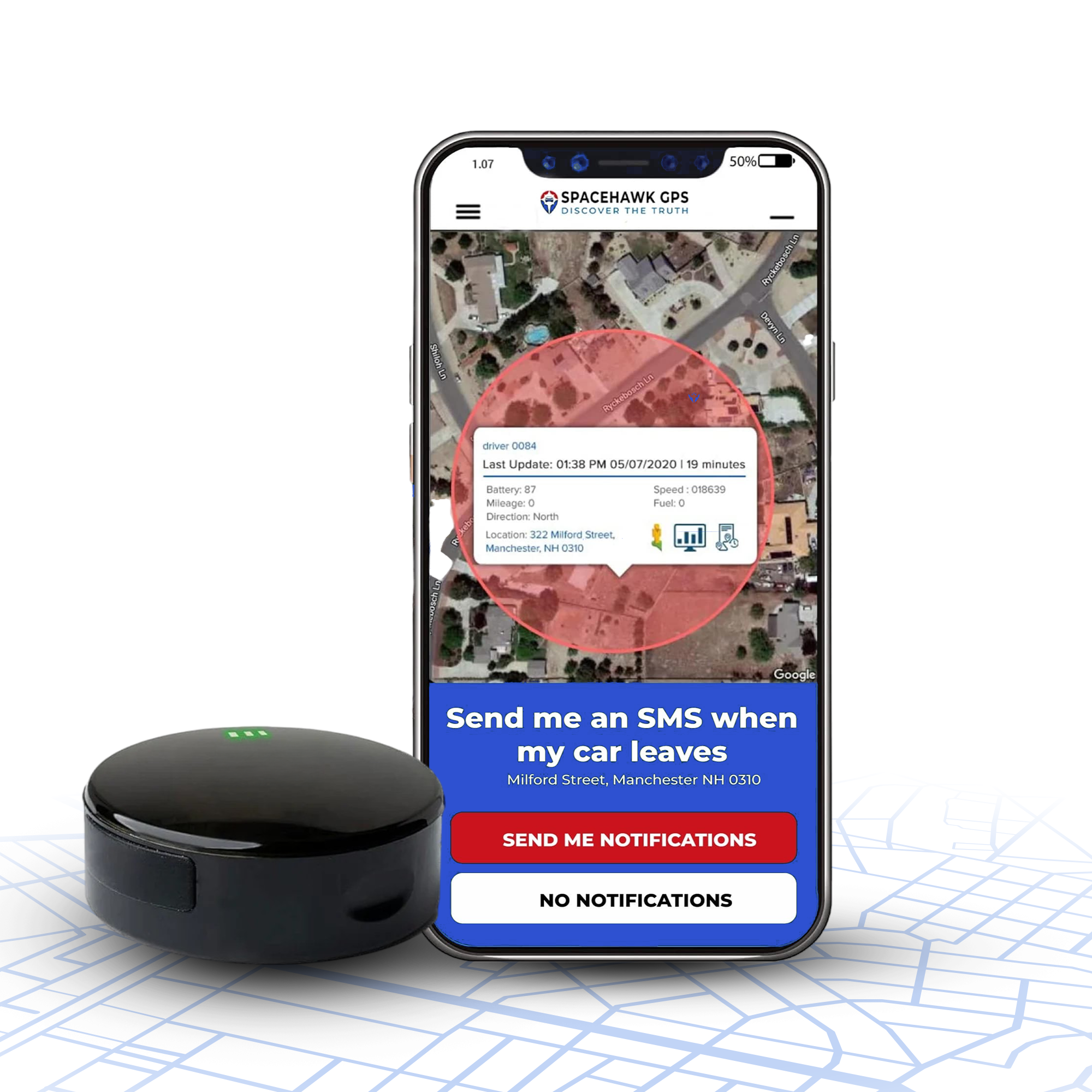
As teens move from lots to real roads, SpaceHawk gives parents location updates and speed alerts. The magnetic case mounts in seconds and needs no wiring, so one unit moves between family cars. Rated 4.1 stars from nearly 100 verified Amazon reviews. Tell your teen the tracker is there. Agreed monitoring is what makes it useful.
What to Practice in an Empty Lot
Space is only useful with a plan. Work through these five in order, and give each one a full session before moving on.
| Skill | What to work on |
|---|---|
| Steering control | Hands at 9 and 3, thumbs along the rim. Practice small corrections and full-lock turns at walking pace. |
| Braking and accelerating | Smooth pressure on both pedals. Aim to stop on a painted line without a jolt. |
| Parking | Pull-in, reverse-in, and parallel between two cones or two lines. Signal every time. |
| Scanning | Mirrors every few seconds, shoulder check before every move. Name hazards out loud. |
| Lot rules | Obey the arrows, stop signs, and the 5 to 10 mph limit. Treat lot lanes as roads. |
The hand position changed. Many parents were taught 10 and 2. Federal safety guidance now points to 9 and 3. Hands high on the wheel can be thrown back when an airbag fires.

UTOPICAR Blind Spot Mirrors
These small convex mirrors clip onto the existing side mirrors and widen the view while reversing and parking. Blind spots cause most beginner parking scrapes. They cost a few dollars and fit in two minutes.
Give a new driver an empty surface and a full hour. Confidence comes from repetition, not from advice shouted across the cabin.
Ryan Horban
GPS Tracking Expert
Lot practice ends and solo driving begins. A plug-in tracker gives you speed alerts and trip history.
See teen driver trackersIs Practicing in a Parking Lot Legal
Generally yes, with two conditions worth checking before you go.
The first is your state's permit rules. Most states expect a learner to hold a permit. A qualified licensed adult also has to sit in the passenger seat. The minimum age for that adult varies, so read your own state's rule rather than assuming 21.
The second is whose land you are on. Public school grounds during off-hours are rarely an issue. A retail lot, a stadium, or a business park belongs to somebody, and they can ask you to leave.
Private property is not a rules-free zone
Some states apply licensing requirements everywhere, not only on public roads. Others do not. The answer changes by state, so the safe course is the same everywhere. Carry the permit, bring a qualified supervising driver, and insure the car.
Check the vehicle too. Brakes, lights, and tire pressure before every session. A flat tire in the middle of a lesson ends the lesson.
Related reading
Wondering what the law says about tracking a family car? Our guide to GPS tracking laws by state covers parental exemptions and consent rules state by state.
Safety Rules for Lot Practice
Same list every session, until the habits stop needing saying.
Do
- Belt on before the engine starts, every time.
- Check mirrors and blind spots before each maneuver.
- Signal in the lot, even with nobody watching.
- Rotate through parking types rather than repeating one.
- Pick off-peak hours so nobody is waiting on you.
Do not
- Touch a phone, either of you.
- Exceed the lot limit, usually 5 to 10 mph.
- Ignore arrows, lines, and signs because the lot is empty.
- Sit close behind another moving car.
- Raise your voice. A rattled driver learns nothing.

Vantrue N4S 3 Channel Dash Cam
A dash cam records what a tracker cannot. GPS gives you location and speed. Video gives you the context behind a sudden stop or a scrape. Check your state's rules on in-cabin audio before enabling the interior microphone.
Keeping Your Teen Safe Once They Drive Alone
The license arrives and the supervision stops overnight. That transition is the risky part, and the numbers are blunt about it.
Nearly 4x
The crash rate for drivers aged 16 to 19 compared with drivers 20 and older, per mile driven. Risk peaks at age 16.
Insurance Institute for Highway Safety, teenagers research overview
A GPS tracker will not make anyone a better driver on its own. What it does is replace guesswork with facts. You see where the car went, how fast it travelled, and whether it left the area you agreed on.
The part parents get wrong is secrecy. A hidden tracker found by a teenager costs more trust than the device ever bought. Researchers who study families and technology are consistent on this.
The key is mentoring, not monitoring.
Dr. Devorah Heitner
PhD in Media, Technology and Society, author of Growing Up in Public and Screenwise
Her argument cuts against covert tracking, and that is exactly why it is worth reading. Say the tracker is fitted, agree what you will look at, and agree what follows a broken rule. Monitoring that everyone knows about changes behavior. Monitoring that gets discovered changes the relationship.

Related reading
New to the hardware? Start with how GPS trackers work, then compare plug-in against hardwired devices.

Prefer a Tracker Your Teen Can See
The Konnect OBD2 tracker plugs into the dashboard port in plain sight. For many families that visibility is the point. Everyone knows the arrangement, and nobody is hunting under a bumper.
- Fits the OBD2 port in under 30 seconds
- Location updates every 3 seconds
- Speed alerts, geofencing, and trip history
- Suits families who prefer open agreements
Frequently Asked Questions
How many hours should a teen practice before the road test?
Road-safety researchers point to at least 70 hours of supervised practice as a graduated licensing best practice. Your state may require fewer. More practice in varied conditions is what actually lowers crash risk, not hitting the legal minimum.
Can my teen practice in a parking lot without a permit?
Rules on private property vary by state, and some apply licensing requirements everywhere. Treat the permit as required, because that is the only answer that works in every state.
What time of day is best for lot practice?
Early Sunday morning is the sweet spot for school and retail lots. Church lots flip that pattern and are quietest midweek during working hours. Night practice in a lit retail lot suits a teen who already has the basics.
Should I tell my teen about a GPS tracker?
Yes. Agreed monitoring changes driving behavior, and a device found by accident damages trust badly. Say what you will check and what happens if a rule is broken.
Sources
From the lot to the open road
Plug-in and magnetic GPS trackers that suit family vehicles, with live location, speed alerts, and trip history.
Shop GPS TrackersAs an Amazon Associate, GPS Tracker Shop earns from qualifying purchases.
About the Author

Frequently Asked Questions
Is It Okay to Practice Driving in a Parking Lot?
Why Are GPS Tracking Apps Not the Best for Safe Teen Driving?
How Are Teens Out-Smarting Parental Safety Measures Like GPS Tracking Apps?
What Driving Skills Should Teens Practice First?
What Is the Best Time To Practice Driving in a Parking Lot?
- Choosing a selection results in a full page refresh.
- Opens in a new window.
 Buy on Amazon