
Best Teen Driving Monitor for Parents (See Every Drive)

5 things every parent should know before buying a teen driving monitor
-
01
Update rate is the spec that matters most. A tracker reporting every 3 seconds shows the turn your teen just took. One reporting every minute shows a guess.
-
02
A battery tracker mounts anywhere on the vehicle and moves between cars. A plug-in unit needs a free OBD2 port and draws power from it.
-
03
Geofence and speed alerts are the features parents actually use. They tell you about a problem while it is still happening.
-
04
Battery life decides how often you handle the device. A plug-in never needs charging. A battery unit runs weeks or months depending on the model.
-
05
Tell your teen the tracker is there. A device they agreed to changes how they drive. A device they discover changes how they see you.
Want live location on your teen driver's car?
The SpaceHawk reports every 3 seconds and moves between vehicles in about a minute.
Affiliate disclosure: this article includes Amazon affiliate links, and qualifying purchases may earn us a commission.

The short answer
SpaceHawk GPS
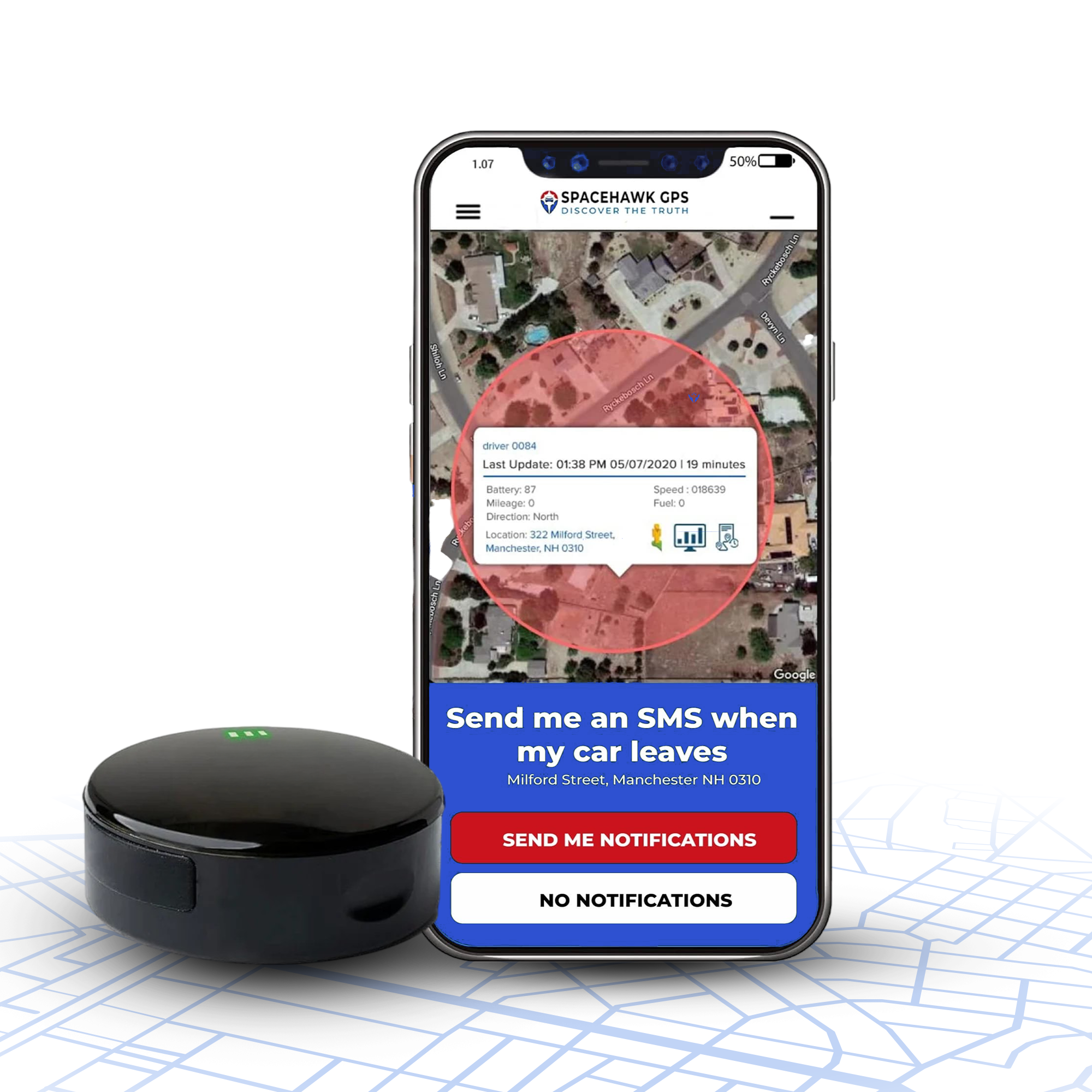
If you want one recommendation and nothing else, buy this one. The SpaceHawk reports location every 3 seconds and lands within about 6 feet. The magnet holds it under any steel panel, so it moves between cars in a minute. The device is $39.95, and the plan runs $19.95 a month, or $9.95 on a two-year prepay.
Full reasoning, and four alternatives, below.
I am Ryan Horban. I have spent 15 years working with GPS vehicle trackers and fleet tracking systems.
Worried about your teen driver gallivanting around town? We get it. We are parents too.
Here at GPS Tracker Shop, hundreds of customers come to us every year for exactly this. Which tracker is the best? Which one is the most accurate? How do you actually use it to keep a new driver safe?
This guide answers all three. Five devices, ranked, with the real running costs written out.
Swipe or scroll the table sideways to compare all five monitors.
| Tracker | 
|

|

|

|

|
|---|---|---|---|---|---|
| Best for | Overall accuracy | Plug and play | Longest battery life | Driver coaching | Video evidence |
| Cost | $39.95 plus $19.95 a month, or $9.95 on a two-year prepay | $39.00, down from $99.00, plus $8.95 a month | $149.95 plus a plan, check the live listing | Check current price and plan | Check current price |
| Live location | Yes, every 3 seconds | Yes, every 3 seconds | Yes | Yes | No, records to a card |
| Buy | Buy Now | Buy Now | Buy Now | Amazon | Amazon |
How this list was put together, plainly. We sell GPS trackers, so read the ranking as an informed opinion rather than a lab result. The ranking rests on published specifications, the units we keep on hand, and what customers tell us after a year.
Prices and plans move. Check the live listing before you buy, and ask any seller for the year-two cost rather than the sticker price.
1. SpaceHawk GPS: Top Overall Teen Driving Monitor

The SpaceHawk is the one we put first, and the reason is the update rate. Location refreshes every 3 seconds and lands within roughly 6 feet. At a minute between reports a car on a main road has already moved a mile.
Setup is the other reason. The magnet holds it under any steel panel, so there is no wiring and no port to occupy. Pair it to the app, set your safe zones, and you are done. Moving it to a second car takes about a minute.
Safe zones cover school, work, a grandparent's house, a friend's place. Leaving one sends a notification. Going over a speed you set does the same. History keeps a year of trips, which helps when you want to discuss a pattern rather than one bad night.
The honest limits: an internal battery needs a recharge every one to three weeks. Heavier use means the shorter end of that range. The housing is waterproof, though we do not publish an IP number for it. The plan is not optional at $19.95 a month, or $9.95 if you prepay two years.
Key features
- 3-second update rate
- Accuracy around 6 feet
- Magnet mount, no wiring
- Geofence and speed alerts
- One year of trip history
- Lifetime warranty
Pros and cons
Pros
- Updates every 3 seconds
- Accurate to about 6 ft
- Moves between cars
- Lifetime warranty
Cons
- Needs a recharge
- Plan is required
- No IP rating published


2. Konnect GPS OBD2: Best OBD2 GPS For Teen Driving

The Konnect plugs into the OBD2 port under the steering column. Every US car built since 1996 has one. There is nothing to charge and nothing to mount, which makes this the easiest install on the list.
Reporting runs every 3 seconds, the same rate as the SpaceHawk. The device is $39.00 at the moment, down from $99.00, and the plan is $8.95 a month flat.
Two honest points. The plan is not included, so ignore any listing that suggests a plug-in tracker costs nothing to run. The unit also sits in plain sight, so it can be unplugged. On a car where everyone has agreed to the tracker that is a non-issue. On a car where nobody has talked about it, it is the first thing that gets pulled.
Konnect does not do driver-behavior scoring. There is no harsh braking or cornering grade here. If a report card is what you want, look at number four instead.
Key features
- 3-second updates from the OBD2 port
- No charging at all
- $8.95 a month flat
Pros and cons
Pros
- Plugs in, no charging
- Updates every 3 seconds
- $8.95 a month flat
Cons
- Needs a free OBD2 port
- Sits in plain sight
- No driver scoring
3. EverLast GPS: Teen GPS With Longest Battery Life

Buy the EverLast if you want to fit a tracker and then genuinely forget about it. The rated runtime is up to 140 days at about an hour of driving a day. A teen who commutes to school and back sits close to that pattern.
That runtime is the whole argument. Every battery tracker dies eventually. The one you forget to charge is flat on the night you need it. Four months between charges removes that failure entirely.
The trade-off is the price. At $149.95 the device costs almost four times what the SpaceHawk does, and there is still a plan on top. Check the live listing for the current plan tiers, because they move.
Key features
- Up to 140 days per charge
- Magnet mount
- Live location tracking
- Geofence alerts
Pros and cons
Pros
- Up to 140 days
- Magnet mount
- Fit it and forget it
Cons
- Costs more up front
- Plan price varies
- Overkill for short trips
4. MOTOSafety By Linxup: Best For Driver Coaching

MOTOSafety is the only device here built around teaching rather than watching. The unit plugs into the OBD2 port, so there is no battery to manage.
The daily driver report card is the feature that sets it apart. You get speeding, hard braking and rapid acceleration summarized for the day rather than as a stream of alerts. Linxup also markets a coaching program alongside it, and maintenance reminders for oil and tire checks.
A report card works best when your teen sees it too. Handing a young driver their own scorecard turns a monitoring device into a feedback loop. The feedback loop is the point of buying this one over the cheaper options.
Costs are not published consistently, so check the listing. Some insurers do offer a discount for a monitored teen driver, though the terms vary by carrier. Ask your agent before you count on it.
Key features
- Daily report card with speed and braking alerts
- Plugs into the OBD2 port
- Maintenance reminders
Pros and cons
Pros
- Daily driver report
- Coaching program
- No battery to charge
Cons
- Monthly plan required
- Uses the OBD2 port
- Pricing is unclear
5. REDTIGER 4K Dual Dash Cam: Best For Video Teen Driving

This one is on the list for a different job. Being precise about that job matters. A dash cam records what happened. A GPS tracker tells you where the car is right now. They are not substitutes.
The REDTIGER shoots front and rear, 4K on the front camera. Night footage holds up well thanks to the wide aperture and HDR. Parking mode keeps recording while the car sits, which is how you find out who hit it in a lot.
What it does not do: there are no geofence alerts, no speed notifications and no live map. The GPS module stamps speed and route into the footage on the memory card. You read that after the fact, from the card or the app, not while your teen is out.
Buy it alongside a tracker rather than instead of one. If a crash ever happens, footage settles the question of fault faster than anything else in this guide.
Key features
- 4K front, 1080p rear
- HDR night recording
- Parking mode
- WiFi and app playback
Pros and cons
Pros
- 4K front and rear
- Good night footage
- Parking mode
Cons
- No live location
- No geofence alerts
- Needs a memory card
Should You Tell Your Teen About The Tracker?
Yes, and this is the part most buying guides skip. A tracker your teen agreed to and a tracker your teen finds are different products. The hardware can be identical and the outcome still is not.
The first one works on the drive. Knowing the car reports speed changes how a new driver takes a corner. That effect starts the day you fit it. The second one works on the relationship, and not in your favor. A device discovered under a bumper reads as a lack of trust, and it usually gets removed.
For a teen driver, the update rate matters more than anything else on the box. A minute-old location is a guess, not an answer.
Ryan Horban, GPS Tracking Expert, GPS Tracker Shop
Have the conversation first. Say what the tracker reports, who sees it, and what you will do with it. Most families land on something simple. The tracker stays through the learner and provisional license period. The device comes off after a clean year. That gives a young driver something to earn.
On the legal side, the ground is solid. A parent tracking a minor child in a vehicle the parent owns is fine in every state. That changes at 18, and it changes again if the car is registered in your teen's name. Several states have tracking statutes that turn on ownership rather than on the family relationship. Our state-by-state guide covers where those lines sit.
Teen GPS Tracker Buying Guide: What To Look For In A Teen GPS Tracker
Parents often shop on the wrong features. The spec sheet leads with battery and price. What actually decides whether a tracker is useful is update rate and alerting. The features below are ranked in the order that matters.
Skip the comparison and take the short answer.
Real-time location tracking
Most trackers claim real-time updates. Plenty of them refresh every 5 to 10 minutes, and a teen can be across town in that window.
Treat 30 seconds as the floor and 3 seconds as the standard worth paying for. The difference shows up the one time it matters.
Geofencing with alerts
Set safe zones for school, work and home, and get a notification on entry or exit. Check that the app allows several zones rather than one.
Alert volume matters too. A tracker that pings you forty times a day gets muted, and a muted tracker is no tracker at all.
Speed alerts you can set
A fixed speed threshold is close to useless. A speed that is fine on a highway is reckless in a school zone.
Look for a limit you choose yourself, and an alert that names the location as well as the speed.
Driving behavior reporting
Hard braking and rapid acceleration are the two habits that predict a crash. Not every tracker measures them, so read the spec rather than assuming.
A daily summary beats a live alert here. Nobody wants a buzz every time their teen stops sharply.
Battery life, or no battery at all
A battery tracker should hold at least a week, and a power-saving mode helps between trips. Anything shorter becomes a chore you stop doing.
A plug-in unit sidesteps the question completely. The trade is that it occupies the port and sits where it can be seen.

GPS Tracking For Teenagers: Why Parents Are Investing In Teen Driving Monitor Devices
The short version: the first year of driving is the dangerous one. A tracker gives you something to work with while it passes.
Having a teen on the road is a running background worry. Where are they, who is with them, how fast are they going. A tracker converts that into information. You see the location, the route, the speed, and whether anything went wrong on the way home.
3x
Fatal crash rate for drivers aged 16 to 19, against drivers 20 and older, per mile driven
That gap is about inexperience rather than character. New drivers are slower to recognize a hazard and more likely to misjudge a gap. Both improve with miles, which is why the risk falls steadily through the first couple of years.
Safe Teen Driving: Strategies And Statistics
Is your teen guilty of texting or talking on the phone behind the wheel? You are not alone. Distraction is the risk that has grown while almost every other one has shrunk.
According to the National Highway Traffic Safety Administration, 3,208 people were killed in crashes involving distracted drivers in 2024. Reading a text takes your eyes off the road for roughly 5 seconds. At 55 mph that is the length of a football field, driven blind.
3,208
People killed in crashes involving a distracted driver in 2024, down about 2 percent on the year before
Timing is the other pattern worth knowing, and it is the one that turns into a household rule. The CDC puts the night-time fatal crash rate for teen drivers at about three times the adult rate. Weekends carry the same skew.
44%
Share of teen crash deaths between 9 pm and 6 am, with half on a Friday, Saturday or Sunday
Passengers matter as well. The CDC finds that crash risk for an unsupervised teen driver climbs with each additional young passenger in the car. A curfew and a passenger limit are the two rules with the most evidence behind them.
Here is what parents can act on tonight:
- Set a curfew. Night driving is where the fatal crash rate roughly triples, so an hour on the clock does real work.
- Limit passengers for the first year. Each extra teen in the car raises the risk again.
- Make the car a phone-free zone, and use the phone's own driving mode rather than trusting willpower.
- Protect sleep. A tired driver reacts slowly, and teens are chronically short of sleep during term.
- Fit a tracker your teen knows about, and review the week together rather than only after something goes wrong.

Related guides
Final Thoughts
Handing over the keys is the scariest promotion a parent ever gives. The first year carries most of the risk, and it passes whether you watch it or not. A monitor turns that year from a knot in your stomach into information you can act on.
Match the device to your family. SpaceHawk gives the live map and the fastest updates. Konnect is plug-in simple at $8.95 a month. EverLast runs a school year on one charge, and MOTOSafety coaches rather than watches. The REDTIGER rides along with any of them for the crash you hope never comes.
Whichever you pick, put it on the table, not under it. Agree on the rules, review the first month together, and let a clean record earn the freedoms back. The tracker watches the car. The conversation is what builds the driver.
Ready to put one in the car?
The SpaceHawk is our pick for a teen driver. Three-second updates, accuracy around 6 feet, and a magnet mount that moves between vehicles in a minute.
Sources: National Highway Traffic Safety Administration, distracted driving data for 2024. Centers for Disease Control and Prevention, teen driver risk factors. Product specifications from each manufacturer's current listing.
About the Author

Frequently Asked Questions
Can I use a cell phone as a teen driving monitor?
What months are most dangerous for teenage drivers?
Can a teen driving monitor help in a roadside emergency?
Can I monitor my teen's driving habits in real time?
Can I restrict my teen's phone use while they are driving?
What is the role of the OBD-II port in monitoring my teen driver?
Do these trackers work on both iPhone and Android?
- Choosing a selection results in a full page refresh.
- Opens in a new window.
 Buy on Amazon