
Police GPS Tracker

5 things to know about GPS trackers in law enforcement
-
01
A magnetic tracker puts a live location on a screen without a pursuit
-
02
Battery life is the spec that decides which unit suits a long case
-
03
A GPS launcher tags a moving vehicle from roughly 10 to 40 feet away
-
04
Tracking patrol cars supports dispatch, mileage records and accountability
-
05
Attaching a tracker to a vehicle counts as a Fourth Amendment search
Equipping an agency or an investigative unit?
Free lifetime USA-based technical support on every device we sell.
As an Amazon Associate we earn from qualifying purchases.

The short answer
EverLast Long Battery GPS Tracker
For surveillance work, runtime beats every other spec. EverLast carries an extended battery pack rated near 140 days. That figure assumes about an hour of vehicle movement daily. Location updates land every 5 seconds. Hardware is $149.95, down from $199.95, and service starts at $17.99 a month on an annual plan.
Full reasoning, plus four alternatives, below.
Police departments, sheriff's offices and task force units buy GPS tracking hardware for two very different jobs. One is investigative. A unit needs to know where a suspect vehicle goes over days or weeks. Under a warrant, and without officers sitting in traffic behind it. The other is administrative. A department wants live positions for its own patrol cars and equipment. Dispatch needs that, and so does the record.
Those two jobs pull in opposite directions on hardware. Investigative work rewards battery life and a magnet. Fleet work rewards a wired unit that never needs charging. Below are five devices agencies actually ask us about, with the spec that decides each one.
| Device | Best for | Battery | Price | Where to buy |
|---|---|---|---|---|

#1EverLast
|
Long investigations | About 140 days | $149.95 | Buy Now |

#2SpaceHawk
|
Compact placement | 1 to 3 weeks live | $39.95 | Buy Now |

#3StarChase Guardian-HX
|
Tagging a fleeing car | A full shift rotation | Agency quote | View Specs |

#4LandAirSea 54
|
Budgeting year one | 7 to 14 days | $249.95 | Buy Now |

#5Spytec Atlas GL300
|
Short deployments | Up to 14 days | Check current price | Buy on Amazon |
How we chose these five
Rankings rest on three things. Published manufacturer specifications, our own hands-on time with several of these units, and what agencies report after buying. Several of the trackers below sit in our own test collection. Every photo and clip on this page is ours rather than stock.

The 5 best police GPS trackers
1. EverLast, the longest runtime on this list
EverLast ships as a mini tracker plus an extended battery pack in a waterproof magnetic case. The published figure is roughly 140 days on about an hour of movement daily. Updates arrive every 5 seconds. On a case running for weeks, that removes a job nobody wants twice. Going back for the unit to charge it.
The trade-off is bulk. EverLast runs 6.37 by 4.75 by 2.12 inches and weighs just over two pounds. Next to a mini magnetic unit that is a big device, so placement options narrow. Service runs $17.99 a month for Basic on an annual commitment, $27.99 for Plus and $34.99 for Premium.
Key features
- Extended battery rated near 140 days
- Location updates every 5 seconds
- Waterproof case with magnet mount
- Geofence and speed notifications
- SOS button on the device
- Free USA-based support for life
Pros
- Runtime measured in months, not days
- 5-second updates while a vehicle moves
- Panic button included on the unit
Cons
- Much larger than a mini tracker
- Just over two pounds with the battery pack
- Needs an active data plan to report
2. SpaceHawk, the compact option at $39.95

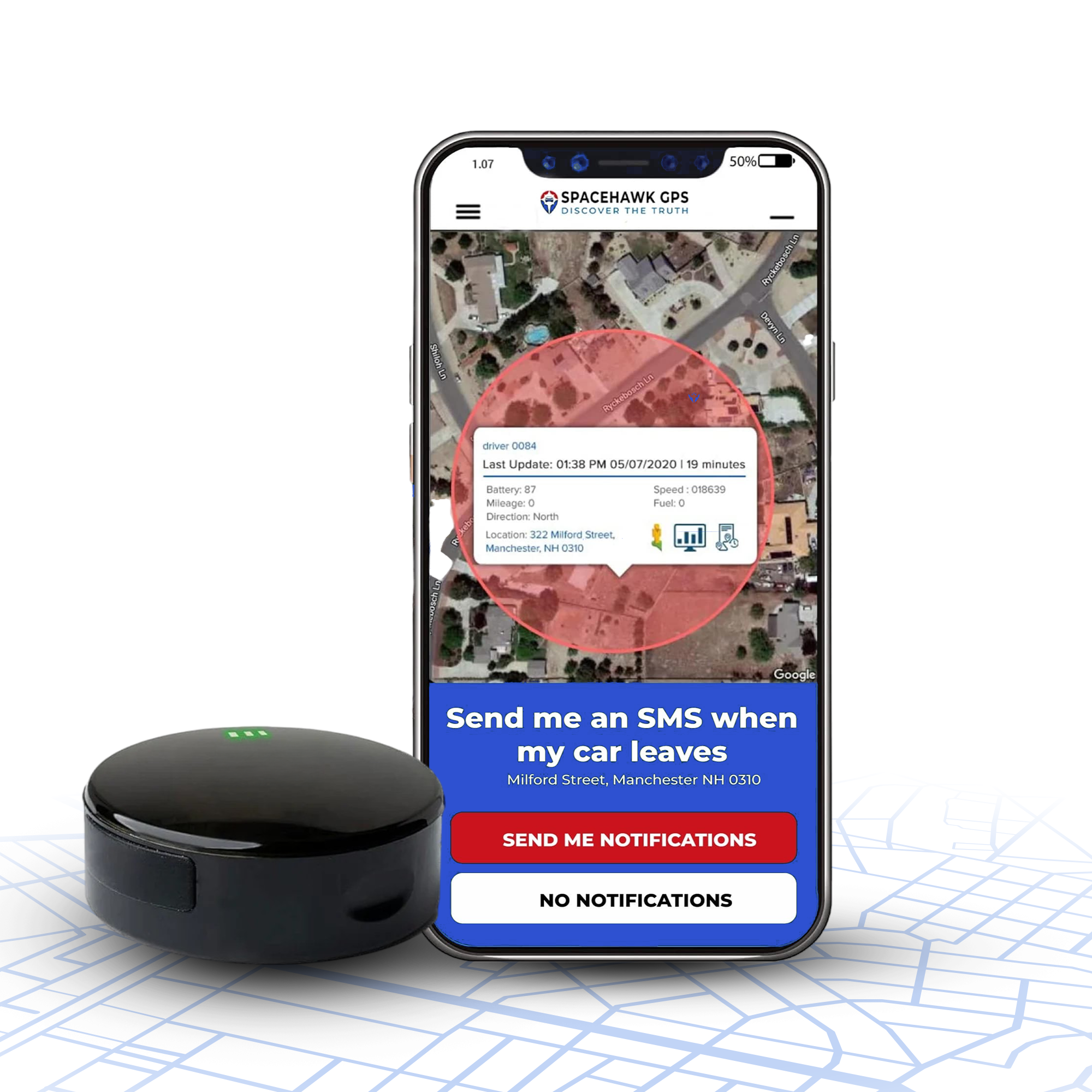
SpaceHawk measures 2.275 inches across and 0.945 inches deep. Placement gets far easier at that size. Updates run as fast as every 3 seconds and accuracy sits around 6 feet. The case is waterproof and the magnet holds without a bracket or a bolt.
Battery depends entirely on which mode a unit runs. Live tracking at 3-second to 3-minute intervals gives 1 to 3 weeks. Low power mode stretches that to 3 to 6 months, at the cost of frequent reporting. Plans are $19.95 a month rolling, or $9.95 a month on a two-year prepay.
Key features
- Updates as fast as every 3 seconds
- Accuracy around 6 feet
- One full year of location history
- Waterproof housing and built-in magnet
- Global SIM covering 150 countries
- Lifetime warranty and free support
Pros
- Small enough for tight placements
- Cheapest hardware on this list
- A year of history for building a pattern
Cons
- Live mode runs 1 to 3 weeks, not months
- Low power mode reports far less often
- No SOS button on the device

Read the battery figure with the mode attached
Every magnetic tracker quotes two very different runtimes, and vendors tend to headline the longer one. For a live case, only the fast-reporting figure matters. In low power mode a device may only check in a few times a day.
Ask any supplier for the runtime at the update rate you actually plan to use. That single question separates the units on this list more than any other spec.
3. StarChase Guardian-HX, a handheld GPS launcher

The Guardian-HX is a single-barrel pneumatic launcher carried by hand. StarChase sells a vehicle-mounted version too, the Guardian-VX. An officer fires an adhesive GPS tag onto a suspect vehicle. Tracking then happens on the CoreView mapping platform rather than in traffic. Reported effective range is 10 to 40 feet.
StarChase certifies the launcher as less lethal rather than non-lethal. That is the standard term for this equipment class. Quote it accurately in a procurement document. Battery packs recharge and cover a full shift rotation. Pricing is quoted per agency and there is no consumer listing.
Key features
- Handheld single-barrel pneumatic launcher
- Effective range of 10 to 40 feet
- Certified less lethal
- Cylindrical rifling and Tacticon optics
- Feeds the CoreView mapping platform
- Ships with a carry case and accessories
Pros
- Tag and track without a chase
- Carried on foot, not bolted to a grille
- Rechargeable packs cover a shift
Cons
- Specialty hardware at a specialty price
- Range caps out around 40 feet
- Sworn agencies only, with training
Watch one deploy before writing it into a budget: StarChase launcher deployment video.
4. LandAirSea 54, the one that bundles year one

The 54 is a small magnetic unit carrying an IP67 rating. Reporting is motion-activated, and the battery averages 7 to 14 days. What separates the version we stock is billing. A twelve-month prepaid subscription sits inside the purchase price. An agency buys once and gets a year of real-time updates. No monthly invoice to process.
Be clear on what happens next. After that first year, a plan is required to keep real-time tracking alive. Pricing runs $19.95 a month, or half that annually. For a department that hates recurring purchase orders, paying up front is often the easier route through procurement.
Key features
- Twelve months of service included
- Motion-activated to save battery
- IP67 rated against dust and water
- Strong surface magnet, no bracket
- Global SIM card in the box
- Lifetime warranty, made in the USA
Pros
- One purchase order covers year one
- IP67 sealing for outdoor placement
- Sleeps when a vehicle is parked
Cons
- Highest upfront cost on this list
- Service resumes billing after year one
- Battery averages 7 to 14 days
Not sure which unit fits the assignment?
Our team has spent 15 years matching hardware to use cases. Call 855-922-8100 or browse the full range. We will say plainly if a cheaper unit does the job.
Browse all trackers5. Spytec Atlas GL300, a familiar workhorse

Atlas and GL300 are the same product. Atlas is the marketing name and GL300 the model number. Plenty of purchasing departments trip over that when comparing quotes. Battery runs up to 14 days at 60-second reporting and drops sharply at faster intervals. The tracker is managed through the Hapn app, since Spytec moved off its own platform.
One correction worth carrying into a spec sheet. Atlas carries an IPX5 rating, covering rain and spray but not submersion. Despite a reputation for toughness, that makes Atlas the least sealed unit here. The weatherproof magnetic case is a separate line item on some listings rather than a given.
Key features
- Up to 14 days at 60-second updates
- Fastest reporting every 5 seconds
- Multi-carrier 4G LTE with a Super SIM
- Managed in the Hapn app
- Magnetic case with strong pull force
- About 3 inches long
Pros
- Long track record with agencies
- Reporting adjustable down to 5 seconds
- Coverage across several carriers
Cons
- IPX5 only, so no submersion
- Subscription costs mount over a year
- Battery falls off at fast update rates


What GPS tracking actually does for a department
Two of the strongest arguments for this hardware have nothing to do with suspects. Both concern a department's own vehicles.
Faster dispatch
Sending the unit genuinely closest to a call, rather than the one that answers first, cuts response times.
Officer safety
A supervisor watching live positions can send backup to a location instead of asking for one over the radio.
A defensible record
Location logs answer where a vehicle was at a given minute. That protects officers as often as exposing problems.
Evidence in an investigation
A tracked route builds a pattern of movement across days, which surveillance on a rotation rarely manages.
Lower running costs
Idling and mileage data feed maintenance schedules and fuel budgets, which is dull work that saves real money.
Recovering equipment
Trailers, generators and specialist kit go missing from yards. Fitting one turns a theft report into a live location.
Fleet tracking and public trust
Vehicle location data now sits inside the accountability conversation in policing. Councils and oversight boards ask about it directly. The honest position is a narrow one. Hardware records where a marked unit was and when, nothing more. Paired with body-worn cameras and a clear retention policy, that record answers a factual question quickly. Complaints usually turn on exactly that.
What it will not do is settle a dispute about conduct. An agency presenting fleet tracking as a transparency measure should say plainly what the data covers. And how long the department keeps it. Overselling the technology is what turns a reasonable policy into a credibility problem later.

Fleet tracking and investigative tracking are two different purchases.
The legal position, stated accurately
Most articles on this subject get the leading case wrong, so it is worth setting out carefully.
The Supreme Court decided United States v. Jones in 2012. Attaching a GPS device to a vehicle counts as a search. So does using that device to monitor where the vehicle goes. The reasoning rested on physical trespass onto the suspect's property. One thing the Court left open: whether that search always requires a warrant. The government had not preserved its argument that the search was reasonable without one.
Two details usually get lost. Officers in Jones did have a warrant. They installed the device on day 11 of a 10-day authorization, in the wrong jurisdiction. And the Supreme Court affirmed the appeals court rather than throwing out evidence itself.
2012
The year the Supreme Court held that attaching a tracker to a vehicle is a Fourth Amendment search
Source: United States v. Jones, 565 U.S. 400
In practice, agencies obtain a warrant supported by probable cause before placing a tracker. That has been the working standard since 2012. Recognized exceptions still apply. Consent, exigent circumstances, and a vehicle already reported stolen, where the thief holds no privacy interest. Any specific deployment is a question for a department's own counsel.
If you are not law enforcement, a different rule applies to you
The Fourth Amendment restrains government actors. A private citizen faces a separate body of law, and the test is ownership. Placing a tracker on a vehicle you own or lease is generally lawful. Placing one on somebody else's vehicle is a crime in many states. Tracking a partner or an ex-partner can also meet the definition of stalking.
The rules vary widely, so check your own state before buying anything: GPS tracking laws by state.
General information only, not legal advice. GPS tracking law turns on case-specific facts and differs by jurisdiction. Consult an attorney about any particular situation.
For an investigative unit, battery life is the spec that decides everything. A tracker that dies on day nine of a two-week case has told you nothing.
Ryan Horban
GPS Tracking Expert
What a police GPS tracker looks like
Hardware falls into three shapes, and the shape follows the job.
Units fitted to a department's own cruisers are hardwired or plugged into the OBD2 port. Power comes from the vehicle, so nobody ever charges them. Investigative units run on batteries, roughly the size of a deck of cards or smaller. Sealed against weather, held on by a magnet. Launcher tags are a third category. Fired onto a vehicle, reporting every few seconds, for a short deployment.

Size is what limits placement, so it belongs at the top of any spec sheet.
Sources
About the author
Ryan Horban has worked with GPS vehicle trackers, fleet systems and asset tracking hardware for over 15 years. He runs GPS Tracker Shop from Southern California.
A note on how this article is funded. Several devices above are sold in our store, and the Amazon links pay us a commission. Rankings still follow the specifications and the use case. The launcher we cannot sell you sits at number three. The cheapest unit here carries a battery warning.
Talk to somebody who has deployed these
Tell us the assignment and the timescale, and we will point you at the unit that fits. Free USA-based support for the life of every device.
Some images in this article were generated using AI.
Police GPS tracker questions
What tracking device do police use?
No single device covers every job. Agencies running long investigations buy battery-powered magnetic trackers with the longest runtime available. EverLast comes up often for that reason. Units watching a department's own fleet are hardwired or plugged into the OBD2 port. Charging never becomes anyone's task.
Specialist and task force units also use GPS launchers such as the StarChase Guardian-HX. The tag attaches from a short distance and reports to a mapping platform. That equipment is sold to sworn agencies rather than to the public.
Can police track your car without a warrant?
Usually not. Since United States v. Jones in 2012, attaching a tracker and monitoring it counts as a Fourth Amendment search. Agencies therefore work through a warrant supported by probable cause. Strictly speaking the Court left the warrant question open. The practical standard since then has been to get one.
Exceptions exist. Consent, exigent circumstances and a vehicle already reported stolen are the common ones. A thief holds no privacy interest in a car that is not theirs. Anyone with a live concern about a specific case should raise it with an attorney.
Can a civilian buy the same trackers police use?
Four of the five devices on this page are sold to anybody. Launchers are the exception and go to sworn agencies only. Businesses buy the same magnetic trackers to protect trailers, plant and tools, and the hardware performs identically.
What changes is the law that applies to you. Officers work under the Fourth Amendment and a warrant. A private buyer works under state tracking and stalking statutes. Ownership of the vehicle is the deciding question there. Track your own assets and you are on solid ground.
How long does a police GPS tracker battery last?
Anywhere from a few days to several months, and the update rate is what decides it. A unit reporting every 3 seconds drains far faster than one checking in hourly. So a single device can honestly claim both a three-week and a six-month figure.
Match the number to the assignment. EverLast is rated near 140 days on about an hour of movement a day. SpaceHawk runs 1 to 3 weeks in live mode and 3 to 6 months in low power mode. Spytec Atlas gives up to 14 days at 60-second reporting.
What does a police GPS tracker look like?
Most investigative units are a plain black box, one to three inches across. The shell is waterproof, with a magnet on one face. Nothing about the casing announces what the device is. A plug-in unit for a department vehicle looks like a small adapter sitting under the steering column.
Launcher tags are different again, roughly the size of a golf ball. Adhesive coating keeps one in place once fired at a vehicle.
- Choosing a selection results in a full page refresh.
- Opens in a new window.
 Buy on Amazon