
7 Best GPS Trackers for Boats & Marine Use (2026)

Best GPS Trackers for Boats and Marine Use (2026)
Ahoy, boat owners! If your boat spends more time at the dock than in your driveway, this guide is for you. Choosing the best GPS trackers for boats can feel like navigating unfamiliar waters.
I know what can keep a boat owner up at night. You want something that keeps tabs on your boat. The right tracker depends on where your vessel spends its nights. A trailer, marina slip, dry storage yard, mooring, and offshore boat all face different risks and coverage limits.
I’ve worked with GPS tracking hardware for more than 15 years, and I’ll be your guide through the options ahead. Think of me as your captain for this ride. I’ll help you match the right tracker to your boat, coverage, battery needs, and budget, so you don’t end up paying for features you’ll never use.
Before we leave the dock, I’ll compare seven options and explain where each one fits. I’ll also tell you which tracker I’d choose for each marine setup.
Key Takeaways
-
01
Your boat’s location determines which GPS tracker fits its storage and usage needs best.
-
02
Cellular trackers lose coverage offshore, while satellite trackers continue reporting beyond coastal cellular coverage.
-
03
Roughly three out of four stolen boats are taken from trailers while stored on land.
-
04
IP67 provides the minimum water protection needed for most marine tracking applications.
-
05
Subscription costs can exceed the hardware price, making long-term pricing important when choosing your tracker.
Protect your boat before the season starts.
Shop GPS TrackersAffiliate Disclosure: As an Amazon Associate we earn from qualifying purchases.
What Is a Boat GPS Tracker and How Does It Work?

A boat GPS tracker is a small device that reports your vessel's position to an app on your phone. Satellites find the location, and a network link sends it. Two separate jobs, and people mix them up constantly.
The whole process runs like this, start to finish.
Step three is where the money and the coverage map get decided. The rest is roughly the same on every device. Our guide to how GPS trackers work goes deeper on the technology.
4,461
Boats were reported stolen in the United States in 2022. That works out to roughly one boat every two hours.
Florida led with 891 of those, and California came second at 656. California sitting second in the country is part of why I pay attention to this from Riverside County.
The number that should shape your thinking is a different one though. More than half of all recovered watercraft come back within a week of the theft. Recovery is a race, and the clock starts when somebody notices. A boat in a storage yard is exactly the thing nobody looks at for nine days.
Which GPS Tracker Is Best for a Boat?

Quick answer
The best GPS tracker for a boat depends on where the boat lives, and seven devices cover the whole range. SpaceHawk suits trailered boats and jet skis at $39.95. Siren 3 wires into a boat kept in the water and watches the bilge pump alongside the location. SPOT Trace runs on satellite for moorings and open water. Outlaw handles long winter storage on one charge. Garmin inReach Mini 3 covers crew safety offshore. Monimoto 9 guards an outboard motor. Oyster3 sits on a stored hull for years without a battery change.
Each one gets a full breakdown below, with what I would skip it for.
The 7 Best GPS Trackers for Boats Compared
| Comparison | SpaceHawk | Siren 3 | SPOT Trace | Outlaw | inReach Mini 3 | Monimoto 9 | Oyster3 |
|---|---|---|---|---|---|---|---|
| Best For | Trailered boats and jet skis | Boats kept in the water | Moorings and open water | Long winter storage | Crew safety offshore | Outboard motor theft | Stored hulls, years unattended |
| Network | 4G LTE + satellite | 4G/5G LTE-M | Satellite only, Globalstar | 4G LTE + satellite | Satellite, Iridium | LTE-M with eSIM | 4G/5G Cat-M1 |
| Water Rating | IP67 | IP67 | IP67 | IP67 | MIL-STD-810 | IP68 | IP68 |
| Battery | 1-3 weeks, 3-6 months low power | Wired to boat power | 4 AAA lithium | 6-12 weeks, 8-12 months low power | Up to 350 hours tracking | Up to 12 months per charge | Up to 10 years on 3 AA |
| Device Price | ~$39.95 | ~$799.99 | ~$79.99 | ~$99 | ~$399 | ~$179 | ~$149.95 |
| Buy Now | Buy on Website | Buy on Amazon | Buy on Amazon | Buy on Website | Buy on Amazon | Buy on Amazon | Buy on Amazon |
A quick word on plans, because the industry hides this one. On SpaceHawk and Outlaw, $19.95 buys three-minute updates. Real time tracking at three seconds is the $49.95 tier. Prepay two years and every tier drops by half.
How I Ranked These Boat GPS Trackers
I tested these boat GPS trackers around real marine scenarios, focusing on coverage, tracking behavior, mounting, battery use, and alerts.
I also compared each tracker’s network coverage, waterproof rating, battery claims, device price, and subscription costs. For features I could not personally test on a boat, I relied on the manufacturer’s published information. I noted that clearly in the individual review.

I focused my testing on Southern California boating conditions. The spots included marina slips around Oceanside and San Diego, coastal areas, boat launches, and storage sites around Murrieta. I also followed routes from Murrieta through Oceanside and Dana Point toward San Diego. Along the way I watched how cellular tracking behaved as units moved from inland toward the coast and open water.
The goal was simple. I wanted to see which tracker fits each boating situation. The range runs from a trailered boat at home to a vessel on open water.
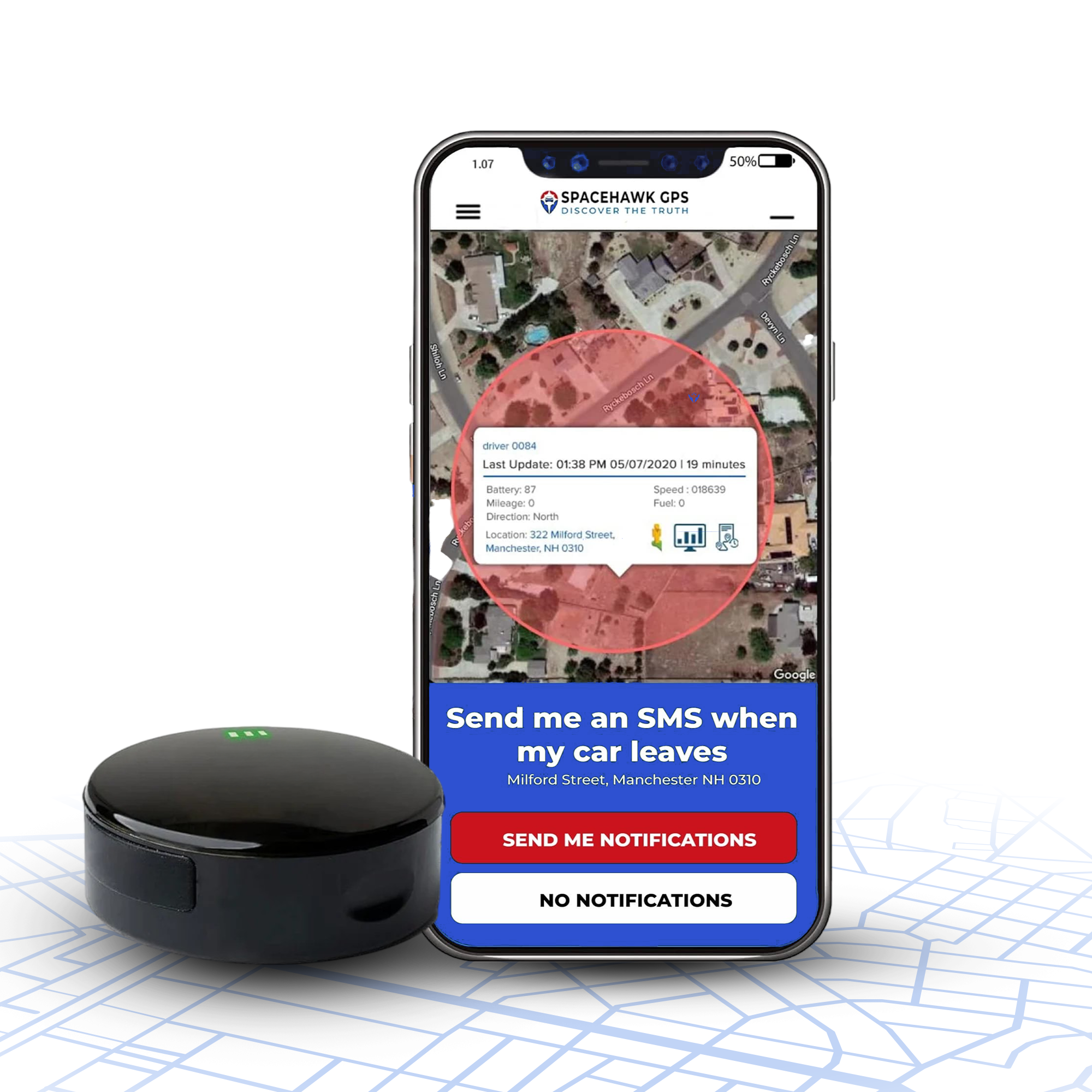
1. SpaceHawk: The Best GPS Tracker for Trailered Boats and Jet Skis

SpaceHawk takes the top spot on straight math. Roughly three out of four stolen boats go off a trailer, usually from a driveway. A $39.95 magnetic tracker covers that risk better than anything costing five times more.
The magnet is what I appreciate most. No wiring, no marine electrician, no holes in the hull. I have moved the same device from a trailer frame to a tow vehicle in about four seconds. Waterproof housing, roughly six feet of GPS accuracy, and a full year of location history. All with a lifetime warranty at the price of a tank of fuel. Where I would skip it.
Cellular in practice, so a mooring with no bars leaves you blind. Best for trailered boats, jet skis and anything stored on wheels.
SpaceHawk Key Features
- Built-in magnet mounts to any steel surface in seconds.
- Waterproof housing rated for permanent outdoor use on boats.
- Location accuracy of roughly six feet under open sky.
- Full year of location history stored in the app.
- Real time tracking at three-second updates on top plan.
- Movement and geofence alerts sent straight to your phone.
- 4G LTE with satellite fallback across 150-plus countries worldwide.
SpaceHawk Pros and Cons
What's Good In The SpaceHawk
- Cheapest device on this entire boat list.
- Install takes seconds with no tools needed.
- Moves between boat, trailer and tow truck.
- Lifetime warranty with free US phone support.
- Full year of history, not thirty days.
- Small enough to hide almost anywhere aboard.
What's Not So Great In The SpaceHawk
- Cellular reporting, so offshore coverage stops working.
- Three-second updates require the $49.95 monthly plan.
- No bilge or battery monitoring is included.
2. Siren 3: The Best Marine Tracker for a Boat Kept in the Water

Siren 3 lands second because location is the smallest problem a floating boat has. Yamaha owns Siren Marine, and this unit wires in as marine equipment with NMEA 2000 and Command Link built in. What I love here is the bilge pump monitoring.
A geofence tells you the hull left the slip. The same app tells you the pump has been cycling all week while you were at work.
One of those calls saves a boat, the other saves a season. $299.99 gets the main device. Plans run $22 monthly, $150 for the May to October season, or $225 a year. Many marine insurance providers discount a policy for a fitted monitoring system. Ask yours before you write off the plan cost. Where I would skip it. Cellular, so offshore reporting stops, and most sensors cost extra at around $129.99 each. Best for a boat living in a slip, on a mooring, or in a covered dock.
Siren 3 Key Features
- Global 4G and 5G LTE-M coverage in most countries.
- Bilge pump monitoring with instant alerts for high water.
- Battery voltage and shore power status tracked continuously onboard.
- Built-in NMEA 2000 plus Yamaha Command Link engine integration.
- Supports six wireless sensors and one wired security sensor.
Siren 3 Pros and Cons
What's Good In The Siren 3
- Watches the whole boat, not only position.
- Purpose-built marine hardware from a boating brand.
- Seasonal plan matches how people actually boat.
- Insurance discounts often available for monitoring systems.
- Remote switching for lights and onboard equipment.
What's Not So Great In The Siren 3
- Costs seven times the SpaceHawk device price.
- Most sensors sold separately near $129.99 each.
3. SPOT Trace: The Best GPS Tracker for Moorings and Open Water

SPOT Trace earns third because satellite is the only honest answer past cellular coverage. No towers involved anywhere. The unit talks to Globalstar, which reaches hundreds of miles offshore. Dock Mode is the feature I rate most on this page, and almost nobody explains why. A hull on the hook rocks and swings all day. A normal motion sensor fires alerts every twenty minutes, and you switch the thing off by Tuesday.
Dock Mode separates water movement from a boat leaving. IP67, four AAA lithium cells, $79.99 right now against a $129.99 list. Where I would skip it. Read the plan page carefully, because $11.95 a month is only the start.
Activation is $29.95. The Flex plan adds a $34.95 yearly charge you pay even while the device sleeps. The 2.5 minute interval is another paid add-on. SPOT also states plainly that Trace has no SOS. This tracks your boat, not you. Best for mooring balls, remote lakes and offshore runs.
SPOT Trace Key Features
- Runs entirely on satellite with zero cellular network dependency.
- Dock Mode built specifically for assets stored on water.
- IP67 rated and submersible one meter for thirty minutes.
- Movement alerts fire from an onboard vibration sensor immediately.
- Daily status message confirming your boat has not moved.
- Four AAA lithium batteries included, no charging cable required.
SPOT Trace Pros and Cons
What's Good In The SPOT Trace
- Works where every cellular tracker goes dark.
- No wiring, no charging, no install needed.
- Dock Mode kills the false alert problem.
- Power-off alert flags tampering with the device.
- Currently fifty dollars under the list price.
What's Not So Great In The SPOT Trace
- Activation costs $29.95 on top of hardware.
- Flex plan adds a $34.95 yearly charge.
- No SOS function at all, per SPOT.
4. Outlaw: The Best GPS Tracker for Long Winter Storage

Outlaw sits fourth on battery life alone. A 4240 mAh cell runs 6 to 12 weeks on standard tracking. Low power mode stretches that to 8 to 12 months, which covers the whole boating off-season on one charge. The runtime is what I appreciate about this unit.
A boat parked in November should still be reporting in March without anyone touching it. Most trackers cannot promise that. IP67, built-in magnet, 4G LTE with satellite fallback, and about the size of a hockey puck at 2.7 inches across. $99 for the device, with plans on the same ladder as SpaceHawk. Where I would skip it. Standard tracking eats the battery far faster than the headline suggests, so the year-long figure needs low power mode.
Best for seasonal storage, dry stacks and boats you visit once a month.
Outlaw Key Features
- 4240 mAh battery running months in low power mode.
- IP67 rated housing built for constant outdoor weather exposure.
- Built-in magnet holding firm on trailer frames and hulls.
- 4G LTE with satellite fallback for wider network coverage.
- Real time tracking down to three-second updates when needed.
- Geofence and unauthorized movement alerts pushed to your phone.
Outlaw Pros and Cons
What's Good In The Outlaw
- Longest low-power battery on this list.
- Magnet mount survives rough trailer roads.
- Same plan ladder as our SpaceHawk.
- Rugged build quality for exposed storage.
- Global SIM covering 155 countries included.
What's Not So Great In The Outlaw
- Twice the SpaceHawk device price.
- Long battery needs low power mode.
“Battery life beats update speed on a boat. A tracker reporting every three minutes for eight months protects a stored hull better than one reporting every three seconds until February.”
Ryan Horban, GPS Tracking Expert
5. Garmin inReach Mini 3: The Best Satellite Device for Crew Safety Offshore

Garmin inReach Mini 3 lands fifth because this device protects people rather than property. Two-way texting on the Iridium network, a color touchscreen, LiveTrack sharing, and weather requests. Interactive SOS routes to Garmin Response, staffed around the clock. The battery runs up to 350 hours in ten-minute tracking mode, and the unit can safety-charge a dead phone.
The SOS is the feature I rate. Having pulled a boat well past cell service toward the islands, I would not run open water without one aboard. Plans start near $14.99 monthly plus a one-time $39.99 activation. More devices in this category live in our guide to GPS trackers with SOS buttons. Where I would skip it. Nobody hides this on a hull, and a thief will not be watched with it.
Best for offshore crews, long crossings and anyone fishing beyond help.
Garmin inReach Mini 3 Key Features
- Two-way satellite texting on the global Iridium network worldwide.
- Interactive SOS routed to Garmin Response staffed every hour.
- Battery lasting 350 hours in ten-minute inReach tracking mode.
- Color touchscreen usable without pairing to a phone first.
- LiveTrack sharing letting family follow your position in motion.
- Weather forecasts requested straight from the device offshore anytime.
- MIL-STD-810 rated build handling impact, water and cold temperatures.
Garmin inReach Mini 3 Pros and Cons
What's Good In The Garmin inReach Mini 3
- Genuine global coverage with no dead zones.
- SOS reaches a real coordination center.
- Works completely without a paired phone.
- Charges your dead phone in emergencies.
- Iridium beats Globalstar for polar coverage.
- Screen readable in direct marine sunlight.
What's Not So Great In The Garmin inReach Mini 3
- Built for people, not theft recovery.
- Activation adds $39.99 to first year.
- Priciest device across this whole list.
6. Monimoto 9: The Best GPS Tracker for Outboard Motor Theft

Monimoto 9 earns sixth for one behavior nobody else copies. This tracker calls your phone in under a minute when the boat moves without the key fob nearby.
A push notification gets slept through, and a ringing phone at 3am does not. The fob is the clever half. Walk away and the unit arms itself, come back and the alarm disarms. Your own trips never trigger anything. IP68, USB-C rechargeable, up to twelve months per charge, two ounces, and small enough to zip-tie behind an engine bracket. $179 with $49 a year after two free months.
Location updates every five minutes in motion, or every minute in live mode, so this is not a pursuit tracker. Best for outboards, jet skis and stored trailered boats.
Monimoto 9 Key Features
- Phone call alert within one minute of detected movement.
- Key fob arming and disarming the tracker completely automatically.
- IP68 rating handling full dust and water immersion outdoors.
- Rechargeable 900 mAh battery lasting up to twelve months.
- GPS, GLONASS and Telit LOCATE improving position under cover.
- Embedded international eSIM working across 4G networks almost everywhere.
Monimoto 9 Pros and Cons
What's Good In The Monimoto 9
- A ringing phone beats silent notifications.
- Fob stops false alerts while boating.
- Cheapest annual plan on this list.
- Tiny enough for engine bracket placement.
- Moves between vehicles in one minute.
What's Not So Great In The Monimoto 9
- Updates every five minutes in motion.
- Device price sits near $179 today.
- Zip-tie mounting only, no magnet included.
7. Oyster3: The Best GPS Tracker for a Stored Hull Left for Years

Oyster3 closes the list on pure endurance. Three AA lithium cells deliver up to ten years at one location update per day. The figure reads like a typo until you understand the tracker sleeps between check-ins.
Mount and forget describes this device honestly. IP68, AES-256 encryption on the location data, and unlimited geofences. Updates come every five minutes or an hour while moving, and every twelve hours at rest. AT&T Cat-M1 and NB-IoT carry the signal. $149.95 with plans at $14.95 monthly or $12.49 billed yearly, no contract and no activation fee.
One thing to flag: no magnets in the box, so mounting means two screw holes or a separate magnet accessory. Best for boats in long storage, dry stacks and unattended marina racks.
Oyster3 Key Features
- Ten year battery life at one daily location update.
- Three AA lithium cells replaceable at any convenience store.
- IP68 housing surviving water, mud, impacts and heavy use.
- AES-256 encryption protecting your location data at the source.
- Unlimited geofences with instant alerts on unauthorized asset movement.
- Twelve hour check-ins while stationary preserving the battery life.
Oyster3 Pros and Cons
What's Good In The Oyster3
- Battery outlasts everything else on here.
- No charging or wiring ever required.
- Yearly plan drops to $12.49 monthly.
- Encryption stronger than most consumer trackers.
- No contract and no activation fee.
What's Not So Great In The Oyster3
- Magnets sold separately as an accessory.
- Sleeps between updates, not real time.
How to Choose the Right GPS Tracker for Your Boat

Choosing the right GPS tracker comes down to five things. The first one is where your boat sits when you are not there. Coverage decides the rest, and you already have that answer from the section above. Run the other four in order and the list narrows itself fast.
What kind of boat are you tracking?
Your boat type sets the mounting spot, the size of the unit, and the threat you are protecting against. Find yourself here.
- Trailered boats, bass boats and anything on wheels: Magnetic tracker on the trailer frame or in the tongue box. Add a second unit on the hull if the two get separated.
- Boats kept in a slip or on a mooring: Hardwired system watching bilge and battery. A sinking costs more than a theft.
- Jet skis and personal watercraft: Compact waterproof unit under the seat, in the hull cavity, or in the glovebox.
- Outboard motors on their own: Small movement-alert device behind the cowling or on the bracket.
Most owners fit two of these, and the good news is one device often covers both. Powersports gear follows the same playbook, and our ATV GPS tracker guide covers that side.

How waterproof does a marine tracker need to be?
IP67 is the floor for marine use. Anything below that will not survive a season of spray, rain and wash-downs. The first number covers dust and the second covers water. A 67 rating means the unit handles a meter of submersion for half an hour. Go to IP68 if the device could ever end up sitting in bilge water. That happens more often than owners expect. SPOT Trace is IP67, while Monimoto 9 and Oyster3 are both IP68.
How long should the battery last?
Battery life for a marine tracker should be measured in months, not days.
Ask yourself how often you will realistically pull the unit and charge it. Once a season is honest for most people. That answer rules out anything quoting two weeks. The exception is hardwiring to boat power and letting shore power carry the load. Replaceable lithium cells sidestep the problem completely, which is how Oyster3 reaches years instead of weeks.
Watch the fine print too, because a headline battery figure almost always belongs to the slowest update setting.
Which alerts do you actually need?

Alerts are what turn a map into protection, and four of them do nearly all the work.
- Unauthorized movement, fired within seconds of the hull shifting.
- Geofence exit, so a departure reaches you instead of a surprise.
- Low battery, because a dead tracker protects nothing.
- Power loss on hardwired units, which is what tampering looks like.
Smart alert systems go further and flag unusual activity rather than any activity. The difference is a useful notification instead of one you learn to ignore.
What will the subscription cost you?
Every tracker here needs a plan, and the plan usually outruns the hardware by year two. Budget the full three years before you compare devices. A $30 tracker with a $25 plan loses to a $180 tracker with a $49 yearly bill. Run that math on your shortlist before you fall in love with a device price.
Cellular coverage or satellite, which does your boat need?
Cellular trackers work near shore, and satellite trackers work everywhere else, so your water decides the hardware. People get one part backwards. Satellites fix the position. Every tracker on this page uses them for that. The difference is how that location data gets to your phone. A cellular unit needs a tower to carry it.

Cell service typically fades a few miles off the coast. Run out past Dana Point and your cellular tracker still knows exactly where you are. Your phone just never hears about it.
For a boat living in a marina, on a trailer, or on a lake with bars showing, cellular wins easily. Cheaper hardware, cheaper plans, faster updates, and the whole map in an app you already understand. A good one logs positions while offline and uploads the backlog once the signal returns. You get the route rather than a gap.
Ask yourself one thing. Would I be past cell service on a normal trip?
Yes means satellite. No means cellular, and you can stop reading the expensive half of this list.
Where Should You Mount a GPS Tracker on a Boat?
Mount the tracker where fiberglass or canvas sits between the device and the sky. Those materials pass a signal cleanly, and metal does not. Skip the engine bay, skip a steel locker, skip anywhere under an aluminum deck plate.

Good spots on most boats. Under a bow cushion, inside a cabin storage locker, behind a side panel, under the gunwale, or in the console.
Vibration is the quiet killer. A magnet that holds fine in a driveway can walk loose over 200 miles of freeway. I have seen units end up on the 15 somewhere between Murrieta and San Diego. Zip-tie anything magnetic as a backup, or add adhesive.
One more thing. Waterproof ratings should be IP67 or better for marine use. Go IP68 if the device could ever sit in standing bilge water.
Conclusion: Which GPS Tracker Should You Buy?
Start with where your boat sleeps, since that answer picks the hardware for you.
Trailer, driveway or yard, buy the SpaceHawk. Thirty-nine dollars covers the scenario behind three out of four boat thefts. No other device on this page costs less to try.
Slip or mooring, buy the Siren 3. Location is the least useful thing that system tells you. Past cellular coverage on a regular trip, buy satellite. SPOT Trace for the boat, inReach Mini 3 for the crew, and plenty of owners running open water carry both. Long storage, buy Outlaw or Oyster3 and forget about charging until spring.
Still comparing brands? Our top 10 GPS trackers roundup ranks the wider field. Whatever you pick, put it on before the season starts. Trackers protect boats. Boxes on a shelf protect nothing.

Protect your boat before the season starts
About the Author

Frequently Asked Questions
Do GPS trackers work on boats offshore?
Does a boat GPS tracker need a subscription?
What does real time tracking actually get you?
Can a GPS tracker stop a theft?
Is a GPS tracker waterproof enough for marine use?
Do GPS trackers work on jet skis?
Will the battery survive winter layup?
- Choosing a selection results in a full page refresh.
- Opens in a new window.
 Buy on Amazon