
How Can I Track My Son’s Car Without Him Knowing

-
01GPS trackers give parents real-time speed and location updates on teen drivers
-
02Magnetic trackers like SpaceHawk hide inside or outside any vehicle discreetly
-
03OBD2 trackers plug into the dashboard port and draw power from the vehicle
-
04Crash risk rises for teen drivers when unsupervised passengers are riding along
-
05Parents generally have the legal right to track a vehicle they own, or a minor's
How to Track Your Son's Car Without Him Knowing
Quick Answer
To track your son's car without him knowing, attach a magnetic GPS tracker to the underside of the vehicle, activate it through the companion app, and monitor his live location, speed, and route history from your phone. No wiring. No mechanic. No conversation required until you decide to have one.
A GPS tracker on your own vehicle, used to know your son is safe, isn't the same thing as spying on someone. It doesn't read his texts or listen to his calls — it just tells you where the car is. Most parents who use one aren't looking to catch their kid doing something wrong; they're looking for the same thing every parent wants: to know he got home okay.
I'm Ryan Horban. Fifteen years working with GPS tracking hardware across personal vehicles, fleet setups, and family safety installs. The call I get most often from parents has nothing to do with fleet management. It's quieter than that. A mother who found something in her son's text messages. A father who noticed the car coming home two hours late with no explanation. A parent who just wants to know their kid got home safe without turning every evening into an interrogation.
This guide covers exactly how to track your son's car without him knowing, which devices actually work, where to place them so they stay hidden, and what the data tells you once you're up and running.
Is It Legal to Track Your Son's Car?

Location-tracking law varies significantly by state, so there's no single blanket rule — but ownership is the consistent thread running through nearly every state that has addressed this. The National Conference of State Legislatures tracks at least 26 states and D.C. that have specific statutes addressing non-consensual location tracking. Several of those — including Delaware, Michigan, and Tennessee — explicitly carve out an exception for a parent or guardian tracking a minor child's vehicle.
Ownership is the controlling factor here. If your name is on the title or the insurance policy, you generally have the legal right to place a tracker on that vehicle. If your son is under 18 and living under your roof, parental authority extends to monitoring his whereabouts and driving behavior, regardless of whose name is on the registration.
The picture changes at 18. Once he becomes a legal adult, tracking a vehicle without his knowledge generally requires that your name remain on the title — monitoring a car registered solely in an adult child's name moves into legally murkier territory in a number of states, so it's worth checking your specific state's statute before assuming the same rules apply.
For parents of minor teens, the situation is much clearer. You own the car, or the law recognizes your parental authority over a minor's vehicle. The legal right to monitor it is generally yours — though laws do change, and this isn't legal advice, so confirm the specifics for your state if you want certainty.
What GPS Tracking Actually Shows You

A GPS tracker does not record conversations, access his phone, or read messages. Worth saying clearly before anything else, because a lot of parents assume it does more than it does, and a few assume it does less.
What it gives you is clean driving data: where the car went, how fast it traveled, how long it stopped at each location, and what time it arrived and departed. That information answers most of the questions parents are actually asking:
- Is he going where he says he's going?
- Is he driving at a safe speed on the highway?
- Was the car parked somewhere unfamiliar after midnight?
- Did he arrive at school during the first period or two hours later?
- Is the vehicle moving at 1 AM when it should be in the driveway?
Those are not surveillance questions. They are parenting questions. A GPS device answers them without requiring a confrontation every single time you need to know something.
How to Track Your Son's Car: 4 Steps
Tracking your son's car takes four steps: choose the right GPS tracker type, activate the device and app, place the unit on the vehicle, and begin monitoring from your phone.
Step 1: Choose the Right GPS Tracker Type

The tracker you choose depends on one practical question: do you want a magnetic GPS tracker that hides with zero wiring, or an OBD2 GPS tracker that plugs into the car's diagnostic port and draws power straight from the vehicle? If you're unsure which option fits your needs, see our guide on Types of GPS Trackers: OBD, Magnetic, Hardwired & More.
Both work. They serve slightly different situations.
Magnetic GPS trackers attach to any metal surface using a built-in magnet. No tools. No appointment. No touching anything under the hood or inside the dashboard. A magnetic unit hides under the vehicle frame, inside a wheel well, or beneath a seat, and transmits live location every few seconds. Battery life runs one to three weeks per charge, depending on how frequently the vehicle moves.
OBD2 GPS trackers plug directly into the diagnostic port under the dashboard, within 24 inches of the steering column on virtually every car built after 1996. If you're considering this style of tracker, see our guide to the Best OBD2 GPS Trackers to compare the top options. Power comes from the vehicle itself, so there is no battery to manage. These devices also surface engine fault codes, giving you an early warning of mechanical problems before a dashboard light appears.
| Tracker Type | Install Time | Best For | Main Drawback |
|---|---|---|---|
| Magnetic | Under 30 seconds | Hidden placement, flexible positioning | The battery needs periodic recharging |
| OBD2 Plug-In | Under 1 minute | Always-on power, engine data | Visible under the dashboard |
| Hardwired | 30 to 60 minutes | Permanent tamper-proof installation | Requires a professional installer |
For most parents in this situation, a magnetic tracker is the right call. Nothing to discover under the dashboard. Nothing that changes the interior of the car. Repositions in under 30 seconds if you need to move it.
Step 2: Activate the Device and App

Activation for most consumer GPS trackers takes under five minutes. Create an account on the platform, register the device using the serial number printed on the unit, and download the companion app to your phone. The vehicle appears on your live map once the tracker acquires a GPS signal outdoors.
Nearly all real-time tracking systems require a monthly subscription for live data, alerts, and trip history access. Confirm what each pricing tier actually includes before purchasing. Some base plans lock geofencing and after-hours alerts behind a higher subscription level.
Step 3: Place the Tracker on the Vehicle

Place the GPS tracker where it has a clear view of the sky, stays securely attached, and is difficult to notice during everyday use. If you want a complete breakdown of recommended mounting spots, read our guide on Where To Hide A GPS Tracker On A Car.
Where you put it determines two things: whether it stays hidden, and whether the signal holds up across different driving conditions.
Best Placement Locations
Under the rear frame rail is the most reliable starting position on any vehicle. It provides solid metal contact, stays away from engine heat, remains difficult to notice during a normal walk-around, and has a clear path to the sky for a consistent satellite signal. This is where I place a magnetic unit first on every vehicle I set up for a parent.
Inside the rear wheel well is a strong alternative on trucks and SUVs with deep housings. Signal quality is excellent, and the location is not visible without physically crouching behind the tire.
Under the front seat is the right choice if exterior placement is not practical. Signal is slightly reduced inside the cabin but remains sufficient for reliable location tracking on most devices.
One thing most people skip: wipe the mounting surface dry before pressing the magnet into place. Moisture, road grime, or grease cuts the magnetic holding force dramatically. Takes two seconds and matters more than almost anything else about the installation.
Step 4: Begin Monitoring From Your Phone

Once the unit is placed and active, open the app and confirm the vehicle appears on the map. Then configure the three alerts that actually matter for teen driver monitoring before you do anything else.
The Three Alerts to Set Up Immediately
-
Speed AlertsFire when the vehicle exceeds a threshold you choose. For teen drivers, 75 mph is a reasonable highway threshold. Tighten it further during school hours or in residential areas if the app supports time-based rules.
-
Geofence AlertsNotify you the moment the car enters or leaves a boundary you draw on the map. Set one around the school. Set one around your neighborhood perimeter. Set one around any location you specifically want to know about.
-
After-Hours Movement AlertsFire when the vehicle moves outside a time window you define. If the car should be parked by 11 PM, any movement after that point sends an immediate push notification to your phone without you having to check anything manually.
Real-World Insight
One situation that came up repeatedly in my work involved parents who set up tracking after something already felt off. A father reached out after his 17-year-old started coming home late on weeknights with explanations that kept changing. He placed a magnetic tracker under the rear frame rail on a Sunday afternoon while the car sat in the driveway. By Thursday, he had four days of trip history. The car was stopping at an unfamiliar address 8 miles from home for 90 minutes every evening before returning. He did not confront his son immediately. He had the data first, which changed the entire tone of the conversation when he eventually sat his son down.
These kinds of outcomes are illustrative of what parents using GPS monitoring commonly experience during the first two weeks of tracking. The data removes the guesswork before the conversation begins.
6 Dangerous Teen Driving Behaviors GPS Tracking Catches

According to the Centers for Disease Control and Prevention, motor vehicle crashes are the second leading cause of death for teenagers in the United States. The National Highway Traffic Safety Administration adds that teenage drivers are involved in fatal crashes at a far higher rate than drivers aged 20 and older per mile driven. The Insurance Institute for Highway Safety attributes much of that gap to inexperience combined with specific high-risk behaviors that GPS data can surface before they result in an accident.
-
Driving Too Fast For Conditions
Speed alerts catch highway thresholds. Trip history catches something more nuanced: average speed through residential streets, school zones, and construction corridors where the posted limit carries more legal and physical risk than a freeway number.
-
Driving Late At Night
The CDC reports that the fatal crash rate at night for teen drivers is about three times as high as it is for adult drivers per mile driven. After-hours movement alerts catch this the moment the vehicle rolls out of the driveway, not the following morning when you notice the car moved.
-
Extended Stops At Unfamiliar Locations
Every stop gets logged: duration, address, arrival time, departure time. A 90-minute stop at an address you do not recognize on a Tuesday at 10 PM is information worth having before you have the conversation, not during it.
-
Too Many Passengers In The Vehicle
The CDC reports that crash risk for teen drivers increases with each additional teenage passenger. GPS does not confirm who is riding along, but driving behavior shifts measurably when an audience is present — speed alert frequency and hard-braking events both tend to increase in those situations.
-
Inconsistent Routes To Known Destinations
When a 12-minute drive to school takes 45 minutes, trip history shows the detour with timestamps and addresses. No need to ask. No room to construct an explanation after the fact.
-
Distracted Driving Patterns
A GPS device does not monitor phone use directly. What it does capture is erratic speed behavior, sharp unexplained acceleration and braking in light traffic, and movement patterns inconsistent with road conditions. Those signatures show up in the data and are worth discussing even without direct evidence of phone use.
Real-World Insight
Not every parent starts tracking because something went wrong. A mother whose son had held his license for three months wanted a behavioral baseline before any incident occurred. She reviewed the trip history each morning for the first two weeks without mentioning the tracker. On day nine, she noticed the car running consistently between 72 and 78 mph through a posted 55 mph stretch of highway. No accident. No ticket. Nothing dramatic. She brought it up at dinner with his own route data pulled up on her phone. He had no argument to make against a timestamped number with his name on it. The speeding stopped within a week.
This is an illustrative example representative of outcomes parents commonly report when GPS data is used in coaching conversations rather than confrontations.
Best GPS Tracker for Tracking Your Son's Car
A magnetic GPS tracker is the best tool for monitoring your son's car without him knowing because it hides on any metal surface, updates location every few seconds, and requires no tools, no wiring, and no professional installation.
SpaceHawk is the specific device I recommend for this use case, and the reasons come down to the practical realities of the situation rather than spec sheet comparisons.
Hiding is the core requirement here. An OBD2 unit under the dashboard works well in many contexts, but it occupies a visible port. A curious teenager who reads about GPS tracking online knows where to look first. A magnetic unit mounted to the exterior frame gives him nothing to find through normal use of the car.
One advantage many parents don't think about until later is flexibility. Families with two cars, or parents who want to switch monitoring between siblings, can move a magnetic tracker in under 30 seconds without opening a door or touching the interior.
SpaceHawk at a Glance

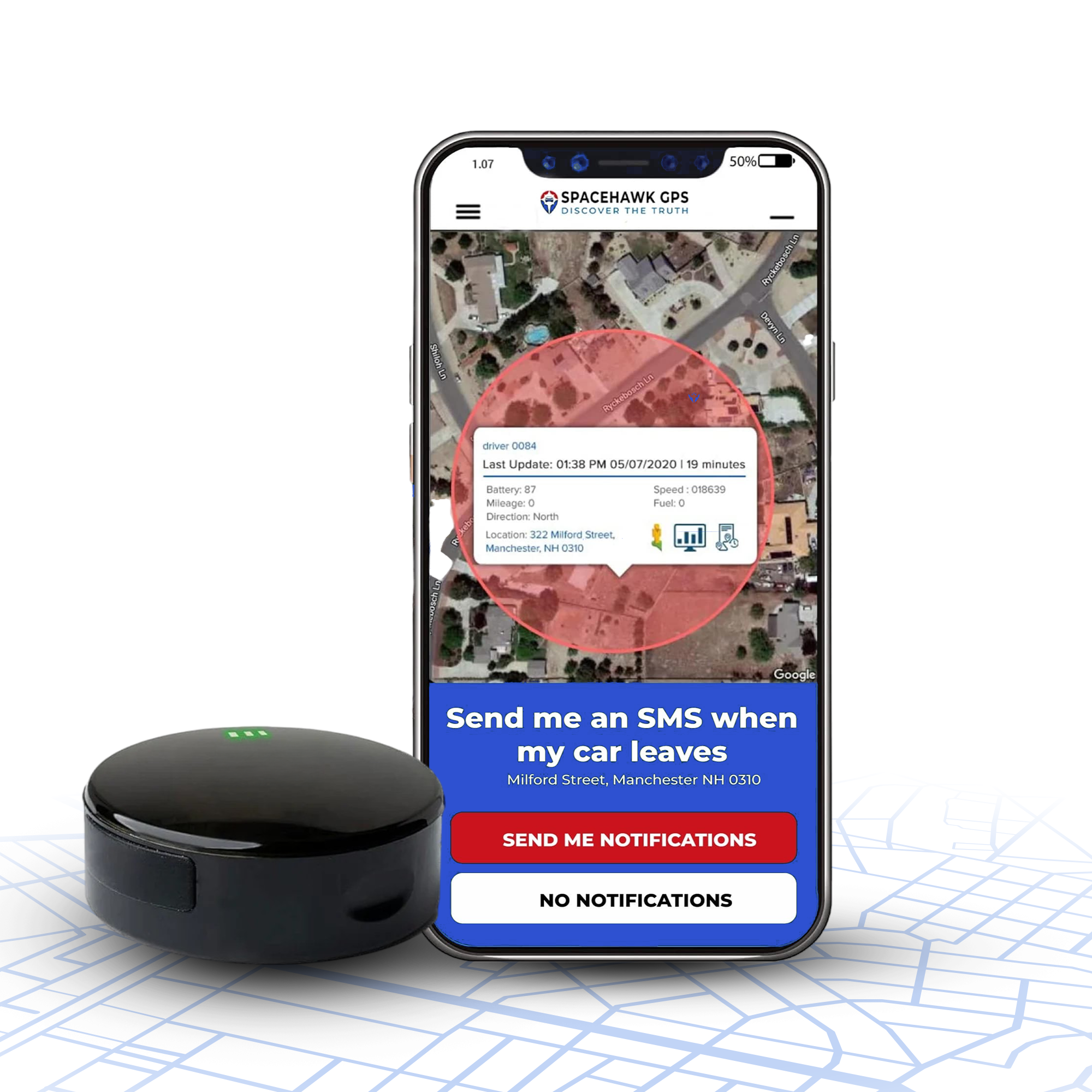
SpaceHawk is a magnetic real-time GPS tracker designed for discreet vehicle monitoring. It delivers location updates every three seconds, runs for up to three weeks on a single charge, and sends speed, geofence, and after-hours movement alerts through its iOS and Android apps.
The compact tracker carries an IP67 waterproof rating, allowing it to perform reliably in rain, dust, and changing road conditions. Its built-in magnet supports quick installation on most vehicles without wiring, making it a practical option for parents who want accurate location tracking and driving alerts with minimal setup.
| Feature | Detail |
|---|---|
| Update interval | Every 3 seconds |
| Battery life | 1 to 3 weeks per charge |
| Waterproof rating | IP67 |
| Placement | Magnetic, interior or exterior |
| App platform | iOS and Android |
| Alert types | Speed, geofence, after-hours movement |
When to Tell Your Teen You're Tracking the Car

Nothing in this guide requires that the conversation never happen. Most family safety researchers and adolescent psychologists who study teen driving behavior suggest that eventual transparency produces better long-term outcomes than indefinite covert monitoring, particularly once a behavioral baseline has been established.
Telling a teenager the car is monitored after two weeks of data collection lands very differently than announcing it on day one or revealing it mid-confrontation after something goes wrong. The sequence matters.
Some parents use the tracker quietly for months and never bring it up. Some disclose within the first few weeks and use it as a deterrent from that point forward. Some wait until an incident gives them a natural reason to have the conversation. All three approaches are legal for parents of minor children. What changes between them is not the legality but the parenting strategy, and that is a decision that belongs to the parent, not the device.
Final Thoughts
The gap between what a teenager says and what is actually happening is not new. What is new is having a clean, legal, low-cost way to close it with objective data rather than suspicion and arguments that go nowhere.
A magnetic GPS tracker mounted under the rear frame rail gives you live location, speed history, stop logs, and configurable alerts from your phone without your son knowing it's there. That data does not replace the parenting relationship. It informs it. Parents who use it well are not spying on their kids. They are making sure they have accurate information before a conversation, not after an incident.
Place it under the rear frame rail. Configure the three core alerts. Check trip history each morning for the first week. The car will tell you what you need to know.
Ready To Give Yourself Peace Of Mind?
SpaceHawk installs in seconds and starts sending real-time alerts the same day.
Shop SpaceHawk GPSAbout the Author

Frequently Asked Questions
Can My Son Detect a GPS Tracker on His Car?
How Long Does the Battery Last on a Magnetic Tracker?
Will It Work Inside a Parking Garage?
What Happens If He Finds the Tracker?
Does a Monthly Subscription Come With the Tracker?
Can a GPS Tracker Work If the Car Is Turned Off?
Can Police Detect a GPS Tracker on a Vehicle?
- Choosing a selection results in a full page refresh.
- Opens in a new window.
 Buy on Amazon