
OBD2 vs Portable GPS Tracker: Bouncie vs SpaceHawk Compared

Key Takeaways
-
01SpaceHawk reacts faster during live vehicle movement and route changes.
-
02Bouncie installs through the vehicle OBD2 port within seconds.
-
03SpaceHawk performs better for hidden GPS tracking and theft recovery.
-
04Bouncie tracks driving habits, trip history, and vehicle diagnostics.
-
05SpaceHawk moves easily between vehicles without permanent installation.
Need concealment more than diagnostics?
SpaceHawk mounts under the vehicle in seconds and keeps tracking on its own battery.
As an Amazon Associate, GPS Tracker Shop earns from qualifying purchases.
OBD vs Magnetic GPS Tracker: Which One Should You Choose?
Magnetic GPS performs better for hidden GPS tracking and theft recovery because the portable magnetic GPS tracker can stay concealed underneath vehicles without relying on vehicle power. OBD2 vehicle tracker focuses more on everyday driver monitoring, route history, and vehicle diagnostics through a plug in OBD2 GPS connection designed for continuous tracking.
I'm Ryan Horban, and over the past 15+ years, I've tested GPS tracking devices across personal vehicles, teen driver monitoring setups, trailers, fleet vehicles, and theft recovery situations. For this comparison, both GPS trackers were tested during highway driving, city traffic, underground parking garages, residential streets, and long-distance route tracking to compare update speed, signal recovery, tracking accuracy, battery life, and real-time location tracking performance.
This guide breaks down how Bouncie and SpaceHawk compare for real-time GPS tracking, installation, battery life, speed alerts, mobile app performance, theft recovery, vehicle diagnostics, and overall everyday usability, so you can decide which GPS tracker fits your vehicle and tracking needs best.
How I Tested These Trackers
Both trackers ran through the same conditions rather than being reviewed from spec sheets. Testing covered highway driving, stop-and-go city traffic, underground parking garages, residential side streets, and long-distance route tracking. SpaceHawk was mounted underneath the vehicle on its magnetic case; Bouncie stayed plugged into the OBD-II port beneath the dashboard, which is the only way that unit installs.
The measures that mattered were update speed during active movement, how quickly each unit recovered a signal after losing sky view, tracking accuracy against the route actually driven, battery behavior over repeated charge cycles, and how each mobile app presented live position and route history. Concealment and removal were checked separately, since that gap is the whole argument between these two designs.
Worth being straight about the limits: this was not a certified lab test. There was no anechoic chamber, no reference-grade GNSS receiver to measure error in centimeters, and no controlled repetition of every run. Cellular coverage, terrain, weather, and where a device sits on a vehicle all move these results, so treat the observations here as field experience across ordinary driving conditions rather than published specifications.
Quick Overview of Bouncie vs SpaceHawk GPS Tracker

SpaceHawk and Bouncie use two completely different GPS tracking approaches. SpaceHawk focuses on hidden real time GPS tracking through a portable magnetic GPS tracker design, while Bouncie works as an OBD2 GPS tracker built for continuous vehicle monitoring, trip history, and driver behavior tracking.
SpaceHawk operates as a battery-powered hidden GPS tracker that attaches underneath vehicles using a strong magnetic mount. Because the tracker does not rely on vehicle power, it works well for covert tracking, theft recovery, construction equipment monitoring, and protecting high value assets. The waterproof shell also helps the GPS device handle rain, mud, road debris, and outdoor weather conditions without losing tracking performance.
Bouncie connects directly into the OBD-II port found on most passenger vehicles manufactured after 1996. The plug in GPS tracker receives continuous power from the vehicle, which removes charging concerns and supports uninterrupted GPS tracking for personal vehicles, teen drivers, and everyday commuting. Bouncie also tracks driving habits like speeding, rapid acceleration, harsh braking, idle time, and route history through built-in vehicle diagnostics.
The difference becomes easier to notice once both GPS tracking devices start moving in real world conditions.
| Product | Best For | Power & Battery | Concealment | Where to Buy |
|---|---|---|---|---|
 SpaceHawk
|
Hidden tracking, theft recovery, trailers and equipment, moving between vehicles | Internal rechargeable battery, roughly 2–3 weeks of normal use; several months in power saving mode | Magnetic mount underneath the vehicle, out of sight | Buy Now |
 Bouncie
|
Teen drivers, family vehicles, daily commuting, driving reports and diagnostics | Continuous power from the OBD-II port, no charging; tracking stops if unplugged | Visible in the cabin below the dashboard | Buy on Amazon |
SpaceHawk Portable GPS Tracker: Built for Hidden Tracking and Theft Recovery
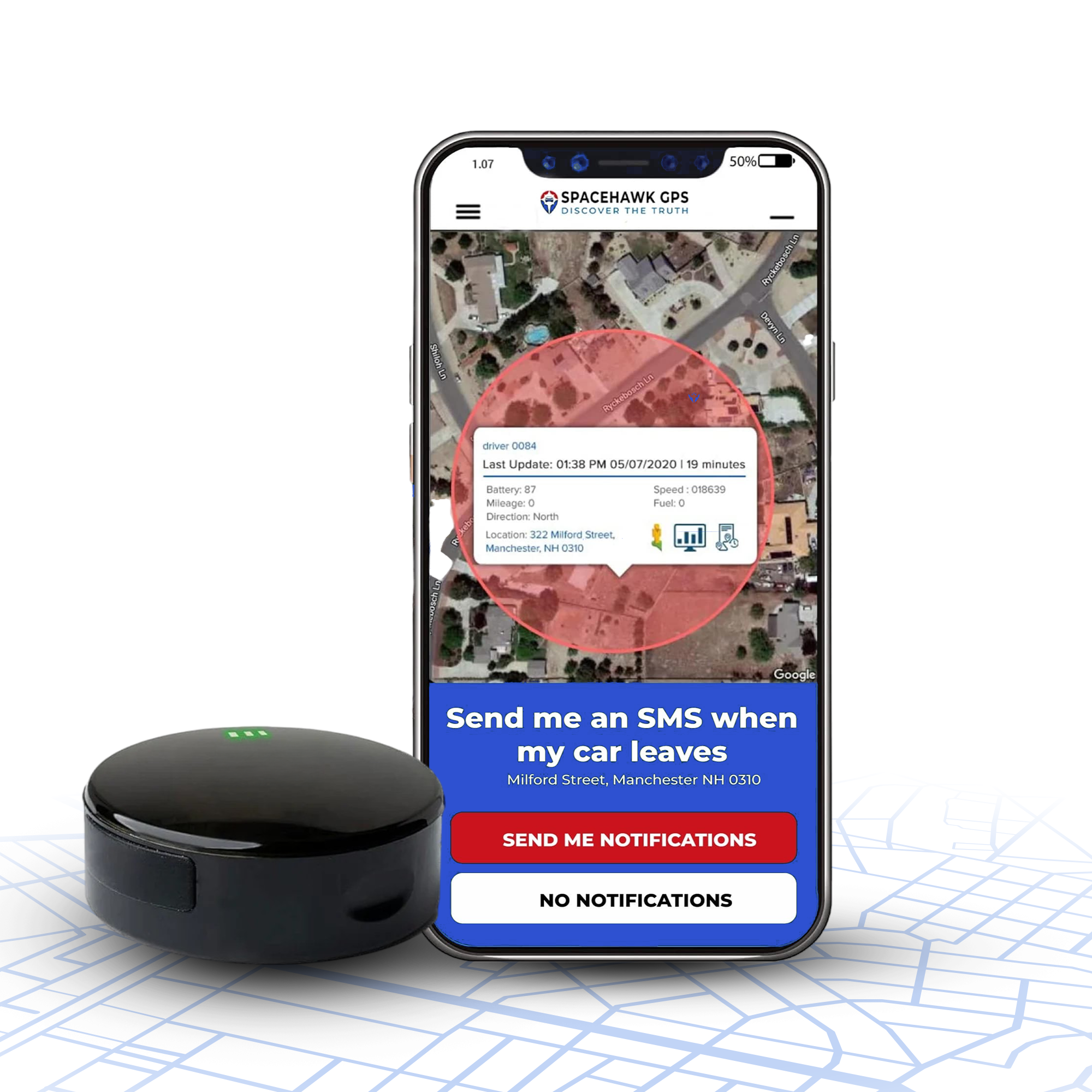
SpaceHawk GPS tracker works as a portable GPS tracker designed for hidden vehicle tracking, theft recovery, and real-time location tracking without permanent installation. Unlike most OBD trackers that stay visible inside the cabin, SpaceHawk uses a magnetic GPS tracker design that attaches underneath vehicles in seconds using a weatherproof magnetic mount.
Because the device runs on an internal rechargeable battery, it continues tracking even if the vehicle loses power. That difference becomes important during theft recovery situations where visible plug-in GPS trackers can be removed quickly.
The compact shell also helped during covert placement testing. The tracker stayed hidden under SUVs, pickup trucks, and fleet vehicles without drawing attention during routine inspections.
Key Features
-
Real-time GPS tracking with frequent location updates
-
Magnetic GPS tracker mount installs in under 30 seconds
-
Hidden GPS tracker design for covert vehicle monitoring
-
Waterproof housing protects against rain, mud, and snow
-
The portable GPS tracker setup works across multiple vehicles
-
Instant alerts for movement, speed, and geofence activity
-
Long battery life with power saving mode support
-
Route history and location history through mobile app access
-
Cellular networks transmit GPS data nationwide
-
Compact mini GPS tracker design fits under most vehicles
Pros & Cons
Pros
- Location updates react quickly during turns and lane changes
- Magnetic mount stays secure under vehicles at highway speeds
- Portable design moves easily between multiple vehicles
- Hidden placement works well for covert monitoring
- Waterproof shell handles rain, dirt, and rough road conditions
- Keeps tracking even when the vehicle loses power
- Route history playback loads quickly
Cons
- Needs periodic recharging, unlike a plug-in unit
- No access to onboard vehicle diagnostics or engine data
- Frequent real-time updates drain the battery faster in heavy city traffic
- Requires an active cellular subscription
- No driving-behavior scoring for teen driver monitoring
Battery performance also held up well during continuous tracking tests. Under normal driving conditions with frequent real-time tracking enabled, the device lasted multiple weeks before needing a recharge. In power saving mode, battery life can extend for several months depending on update frequency and movement activity.
Because SpaceHawk does not depend on vehicle wiring, the tracker works well for tracking devices placed on trailers, construction equipment, fleet vehicles, and personal vehicles that move between different locations.
Real-World Insight
Across highway testing and stop-and-go city traffic, SpaceHawk reacted quickly when vehicles changed direction or entered side streets. The map refreshed fast enough to follow live movement without long gaps between location updates.
In one recovery simulation, the tracker remained connected after the vehicle stayed parked inside a multi-level garage for nearly two hours. Once the vehicle returned to open roads, the GPS signal recovered quickly and updated the exact location within seconds.
The magnetic mount also stayed secure over rough pavement, at highway speeds, and through sudden braking.
Best For
- Theft recovery and covert vehicle tracking
- Monitoring teen drivers without visible hardware
- Tracking construction equipment and high-value assets
- Fleet tracking across multiple vehicles
- Portable tracking without wiring installation
- Vehicle GPS tracker use in personal or commercial vehicles
One reviewer running several units across multiple vehicles rates the magnet as strong and the iOS app as straightforward with no real learning curve. Battery life is described as decent but faster to drain on long trips, which hardwiring addresses. On cost, the reviewer notes that prepaying brings the plan down substantially from the headline monthly figure, and points out the LED can be switched off to keep the unit discreet. Repeat purchases came from needing more units rather than replacing failed ones.
Running one tracker across a car, a trailer, and a work truck? The magnetic mount moves in seconds — no second install.
Buy NowBouncie OBD2 GPS Tracker: Fast Installation with Smart Driving Reports
Bouncie GPS tracker works as a plug in GPS tracker built for everyday vehicle monitoring, trip history tracking, and driver behavior reporting through the vehicle's OBD2 port. Unlike portable GPS tracking devices that rely on internal batteries, Bouncie receives direct power from the vehicle, which allows continuous tracking without charging interruptions.
Installation takes less than 30 seconds. You simply plug the GPS device into the OBD-II port and activate tracking through the mobile app. Because of that, Bouncie fits drivers who want immediate real time GPS tracking without dealing with wiring, charging schedules, or magnetic placement underneath vehicles.
Vehicle diagnostics became one of the strongest advantages during everyday driving use. Bouncie pulls engine-related tracking data directly from the vehicle system, which helps monitor driving habits, mileage, route history, idle time, and maintenance behavior across personal vehicles and family cars.
The mobile app also focuses heavily on driver activity reporting. Across daily driving routes, the app tracked speeding, rapid acceleration, harsh braking, and trip playback consistently.
Key Features
-
Plug in GPS tracker installation through the OBD2 connection
-
Real time GPS tracking through cellular networks
-
Vehicle diagnostics and engine monitoring
-
Route history and driving behavior reporting
-
Speed alerts and instant notifications
-
Continuous power without battery charging
-
Mobile app access for location tracking and trip review
-
Driver behavior monitoring for families and teen drivers
-
Idle reports and mileage tracking
-
GPS tracking solutions for personal vehicles and everyday driving
Pros & Cons
Pros
- Plug-in setup takes only a few seconds
- Continuous tracking with no battery management
- Vehicle diagnostics and driving habits reports stay accurate
- Speed alerts and trip notifications work well during daily commuting
- Route history stays detailed during long-distance driving
- Mobile app dashboard organizes tracking data clearly
- Driver behavior monitoring suits teen drivers and family vehicles
Cons
- Stays visible in the cabin and can be pulled out in seconds
- Tracking stops immediately if the unit is unplugged
- Only works on vehicles with an OBD-II port, generally 1996 and newer
- Slight movement lag during sudden route changes and stop-and-go traffic
- Slower to restore tracking after parking garages and dense urban streets
- Cannot be moved to a trailer, equipment, or any asset without an OBD port
The direct power connection also supports uninterrupted GPS data transmission during long driving sessions. Unlike portable units that require battery management, Bouncie keeps reporting location updates as long as the vehicle remains powered.
Because the tracker connects directly to the onboard diagnostic system, Bouncie only works on vehicles equipped with an OBD-II port, which includes most passenger vehicles manufactured after 1996.
Real-World Insight
Across downtown traffic and interstate driving, Bouncie maintained reliable location tracking and detailed route history throughout long-distance sessions.
The strongest performance appeared in everyday commuting, where continuous power allowed nonstop tracking data collection without interruption. Trip playback remained accurate, and the app organized location history clearly across multi-stop routes.
One limitation became noticeable during concealment testing. Because the tracker stays plugged into the OBD-II port below the dashboard, the GPS device remains easier to spot compared to hidden GPS trackers mounted underneath vehicles. In theft recovery simulations, removal only required a few seconds once the tracker became visible inside the cabin.
Still, for family vehicles and teen driver monitoring, the plug-and-play setup felt much more convenient day to day.
Best For
- Monitoring teen drivers and family vehicles
- Tracking driving habits and route history
- Everyday vehicle GPS tracking
- Vehicle diagnostics and maintenance monitoring
- Drivers who want simple GPS tracker installation
- Long-term location tracking without charging batteries
One reviewer bought a single unit to trial in southern Ontario and reported roughly a second of delay, with performance holding up everywhere except areas where cell service is already thin. After a few months of testing, the reviewer ordered units for an entire taxi fleet, and stressed that following the calibration steps matters for getting the best results.
SpaceHawk GPS Tracker — hidden, portable, weatherproof
If the reason you want a tracker is that someone might take the vehicle, the tracker cannot be sitting in plain sight under the dashboard. SpaceHawk mounts underneath on its own battery, so it keeps reporting whether or not the vehicle has power.
- Magnetic mount
- Waterproof shell
- Real-time alerts
- Moves between vehicles
Bouncie vs SpaceHawk GPS Tracker: Head-to-Head Comparison

Now that both GPS tracking devices have been tested individually, comparing how they perform during everyday driving, theft recovery situations, teen driver monitoring, and continuous vehicle tracking becomes easier.
SpaceHawk and Bouncie both deliver real time GPS tracking through cellular networks, but the overall experience changes depending on how the tracker gets power, where it is installed, and how quickly it reacts while vehicles are moving.
Across back-to-back testing through city traffic, highway driving, underground parking garages, and residential routes, each GPS tracker performed better in different areas.
SpaceHawk handled covert tracking and movement response more effectively. Bouncie delivered stronger everyday driving reports, trip history tracking, and plug-and-play convenience for family vehicles and daily commuting.
Real-Time Tracking Accuracy

Real-time tracking accuracy remained strong on both vehicle trackers during normal driving conditions, but update speed and movement response created noticeable differences once vehicles started making rapid turns or lane changes.
SpaceHawk refreshed location updates faster during active movement. Through downtown traffic and multi-lane highway routes, the tracker reacted quickly when vehicles exited side streets, parking structures, or changed direction unexpectedly. The map stayed closer to the vehicle's exact location without long tracking gaps.
Because the portable GPS tracker relies on aggressive update intervals, live tracking felt smoother during continuous driving.
Bouncie also maintained accurate GPS data and reliable route history, especially during long-distance driving and everyday commuting. The tracker handled trip playback, speed alerts, and driving habits reporting consistently through the OBD2 connection. On routine drives, tracking remained stable and reliable.
The difference appeared during sudden route changes and stop-and-go traffic. Bouncie occasionally showed slight movement lag before updating the vehicle's latest position on the map.
Signal recovery also varied slightly in difficult environments. Inside underground parking garages and dense urban streets, SpaceHawk recovered GPS signals faster once vehicles returned to open areas. Bouncie restored tracking shortly after, but the refresh delay remained slightly longer during movement recovery testing.
Tracking Accuracy Winner
- SpaceHawk performs better for fast-moving live tracking and covert monitoring
- Bouncie performs better for steady route history and daily driving reports
Battery Life and Power

Battery life works very differently between these GPS tracking solutions because both trackers use separate power systems.
SpaceHawk runs on an internal rechargeable battery designed for portable tracking without relying on vehicle power. Under normal real world conditions, battery life typically lasts between 2 to 3 weeks depending on update speed, movement frequency, and alert activity. With power saving mode enabled, some users report several months of standby tracking between charges.
Frequent real time GPS tracking drains battery faster in heavy city traffic because the tracker constantly sends location data through cellular data networks.
Still, battery independence gives SpaceHawk a major advantage for covert tracking and asset protection because the tracker continues operating even when separated from the vehicle.
Bouncie removes charging concerns completely. The plug in GPS tracker receives continuous power directly from the vehicle's OBD-II port, allowing uninterrupted GPS tracking without downtime caused by battery depletion. This setup works especially well for teen drivers, family vehicles, and everyday commuting.
The limitation is simple. If the tracker gets unplugged from the vehicle, tracking stops immediately.
Battery and Power Winner
- SpaceHawk performs better for portable tracking and covert use
- Bouncie performs better for nonstop vehicle-powered tracking
Installation and Setup

Installation remains one of the biggest differences between SpaceHawk and Bouncie GPS tracker systems.
Bouncie uses a plug-and-play setup designed for fast activation. Most users can install the GPS device in under 30 seconds by plugging it directly into the OBD-II port beneath the dashboard. Once connected, the tracker immediately starts transmitting location tracking data through the mobile app. Because no charging or magnetic mounting is required, Bouncie feels easier for beginners and daily vehicle monitoring.
SpaceHawk takes a different approach. Magnetic GPS trackers like SpaceHawk can be installed in seconds by attaching directly to metal surfaces without wiring or tools.
The portable design also allows one tracker to move between personal vehicles, trailers, construction equipment, and high value assets without permanent installation. Across testing, the magnetic mount stayed secure over rough pavement, at highway speeds, and on uneven roads.
Installation Winner
- Bouncie performs better for quick plug-in setup
- SpaceHawk performs better for flexible placement and covert installation
Theft Recovery Performance

Theft recovery performance created the biggest separation between these GPS trackers in real-world conditions.
SpaceHawk performs much better for hidden tracking because the compact magnetic GPS tracker can remain concealed underneath vehicles where thieves are unlikely to search. The waterproof shell also protects the device during outdoor exposure, rain, dirt, and road debris.
Across recovery simulations, the hidden GPS tracker continued transmitting location data after vehicles remained parked for extended periods. Because the tracker operates independently from vehicle power, removal becomes much harder unless someone physically searches underneath the vehicle.
Bouncie works differently. Since the tracker remains plugged into the dashboard OBD2 port, the GPS device stays visible inside the cabin area. Removal only required a few seconds once the tracker became visible.
That limitation becomes less important for family driving and route monitoring, but it reduces effectiveness for covert tracking situations.
After a stolen car fled a Menlo Park traffic stop on May 23, 2026, officers tagged it with a StarChase GPS dart instead of chasing it, tracked the vehicle out of San Mateo County into Berkeley, and arrested three teenage occupants. Police put the dart's stick rate at roughly 60 percent. The device is a law-enforcement pursuit tool rather than a consumer tracker, but the principle is the one that matters here: a live location beats a description, and it lets the people recovering a vehicle pick the safe moment to move.
Theft Recovery Winner
- SpaceHawk performs significantly better for hidden tracking and recovery
- Bouncie works better for visible everyday vehicle monitoring
Vehicle Diagnostics

Vehicle diagnostics remain one area where Bouncie clearly holds the advantage.
Because the tracker connects directly into the vehicle's onboard diagnostics system, Bouncie monitors engine-related data alongside GPS tracking. Drivers can review driving habits, speed alerts, idle reports, mileage, fuel usage trends, and route history directly from the app.
Parents monitoring teen drivers benefit heavily from these reports because the system tracks speeding, rapid acceleration, and harsh braking activity during everyday driving. Across city traffic and highway routes, Bouncie tracked braking patterns and driving behavior consistently.
SpaceHawk focuses more on location tracking than engine reporting. The portable GPS tracker delivers strong real-time location tracking, instant notifications, and route playback, but it does not access onboard vehicle diagnostics.
Vehicle Diagnostics Winner
- Bouncie performs better for driving reports and engine monitoring
- SpaceHawk performs better for portable covert GPS tracking
Alerts and Notifications

Both GPS trackers support instant alerts for movement activity, geofencing, and location tracking changes, but update timing differed slightly during active driving tests.
SpaceHawk delivered faster instant notifications when vehicles started moving or crossed predefined boundaries. In city traffic testing, movement alerts appeared within seconds after vehicles left parked locations. The faster response helped in live covert tracking situations where quick location updates became more important.
Bouncie also handled speed alerts, trip notifications, and driving behavior alerts consistently. Notifications for harsh braking, speeding, and rapid acceleration worked especially well for teen driver monitoring. Because the tracker continuously receives power, notifications remained stable throughout long-distance driving.
Alerts Winner
- SpaceHawk performs better for rapid movement alerts
- Bouncie performs better for driving behavior notifications
Design and Concealment

Design flexibility changes how these GPS tracking devices perform in real-world situations.
SpaceHawk uses a compact mini GPS tracker body with a magnetic mount and a waterproof shell designed for hidden placement underneath vehicles. The tracker stays concealed easily and works well for covert monitoring, personal vehicles, trailers, and asset protection. Because the portable units are not tied to one vehicle, the tracker can move quickly between different tracking situations.
Bouncie uses a visible plug-in vehicle tracker design attached directly beneath the dashboard. While installation remains easier, concealment becomes more difficult because the tracker stays exposed near the OBD2 connection.
For family drivers and everyday commuting, visibility usually is not a major concern. For covert tracking, the difference becomes much more important.
Design Winner
- SpaceHawk performs better for concealment and portability
- Bouncie performs better for permanent everyday vehicle use
Subscription Costs

Most tracking devices require monthly subscription plans because they use cellular service and LTE data plans to transmit location data in real time. SpaceHawk and Bouncie both require activation and recurring service after purchasing the hardware.
Monthly subscription costs for GPS trackers typically range from $6.95 to $44.95 depending on:
-
Update speed
-
Data usage
-
Alert frequency
-
Tracking history storage
-
Cellular coverage
-
Driver reporting features
Short-term plans can reduce overall cost for temporary tracking needs, while longer plans usually lower monthly pricing. Across comparison testing, both systems delivered stable cellular data performance in city traffic, on suburban roads, and along highway routes.
Subscription Value Winner
- SpaceHawk performs better for flexible covert tracking value
- Bouncie performs better for long-term everyday driving monitoring
Mobile App Experience

SpaceHawk focused more on live tracking visibility and movement playback. The app refreshed route movement quickly and displayed real time location tracking without much lag during active driving. Playback history also loaded quickly while reviewing route changes and parked vehicle activity.
Bouncie focused more on trip summaries, driving reports, and vehicle activity management. Alongside GPS data, the app displayed driving habits, idle reports, speed alerts, and route history through a cleaner dashboard-style interface designed for everyday users.
Parents and family drivers will likely prefer Bouncie's reporting layout. Drivers focused on live covert tracking may prefer SpaceHawk's faster refresh behavior.
Mobile App Winner
- SpaceHawk performs better for active live tracking
- Bouncie performs better for trip reporting and driver monitoring
Customer Support and Warranty

Both tracking device companies provide customer support through phone, email, and online troubleshooting assistance.
SpaceHawk support focused more on activation help, placement guidance, and real time tracking setup. Response times stayed consistent for account setup and tracking questions.
Bouncie provided stronger onboarding guidance for first-time users, especially during app setup, OBD2 installation, and trip reporting configuration.
Warranty coverage and replacement terms vary depending on retailer, subscription plan, and hardware package.
Customer Support Winner
- SpaceHawk performs better for tracking-related setup guidance
- Bouncie performs better for beginner-friendly onboarding assistance
What I Liked About Each Tracker
SpaceHawk worked better for covert tracking, portability, and theft recovery.
Bouncie felt more practical for everyday driving reports, vehicle diagnostics, and family vehicle monitoring without worrying about charging schedules.
SpaceHawk GPS Tracker

SpaceHawk handled active movement tracking better in real-world conditions, especially while driving through city traffic, underground parking garages, and multi-lane highway routes.
One thing I liked most was the placement flexibility. Because the tracker does not depend on vehicle power, it worked equally well on trailers, construction equipment, personal vehicles, and high-value assets without requiring separate installation setups.
Bouncie GPS Tracker

Bouncie performed best during long-term daily driving where continuous power and driver monitoring became more important than concealment.
The biggest advantage was convenience. Once plugged into the OBD-II port, the vehicle tracker immediately started transmitting location data without dealing with charging cycles or magnetic placement. For everyday driving and family vehicle monitoring, the simple setup made long-term GPS tracking much easier to manage.
Choosing the Right GPS Tracker for Your Driving Needs
Both tracking devices perform well, but the better choice depends on how you plan to use the tracker every day.
SpaceHawk works better for hidden tracking, portable monitoring, and theft recovery situations where concealment and fast real time location tracking become most important.
Bouncie fits drivers and families who want continuous tracking, vehicle diagnostics, trip history, and simple plug-and-play installation without dealing with battery charging.
Choose SpaceHawk If
SpaceHawk makes more sense if your priority is covert GPS tracking and flexible placement across different vehicles or assets.
- You need a hidden GPS tracker for theft recovery
- You want real-time GPS tracking with fast movement updates
- You plan to track personal vehicles, trailers, or construction equipment
- You prefer a magnetic GPS tracker without wiring installation
- You need portable GPS tracking devices for multiple vehicles
- You want tracking to continue even when the vehicle is turned off
- You need a waterproof GPS device for outdoor conditions
- You want better concealment underneath vehicles using a magnetic mount
- You track high-value assets that require covert monitoring
- You prefer battery-powered tracking without depending on vehicle power
Across testing, SpaceHawk performed better whenever concealment, portability, and active movement tracking became important.
Choose Bouncie If
Bouncie works better for drivers who want steady vehicle monitoring and onboard diagnostics through a permanent plug-in GPS tracker setup.
- You want the installation completed in under 30 seconds
- You prefer continuous tracking without charging batteries
- You need vehicle diagnostics and engine reporting
- You want driver behavior monitoring and speed alerts
- You need detailed route history and trip reports
- You monitor teen drivers and their everyday driving habits
- You want GPS tracking solutions with a simple app setup
- You prefer OBD trackers connected directly to the vehicle
- You want instant notifications for speeding and harsh braking
- You need long-term vehicle tracking for daily commuting
During long driving sessions, Bouncie handled continuous GPS data reporting and vehicle diagnostics more efficiently because the tracker stayed powered directly through the OBD-II connection.
Final Verdict: SpaceHawk or Bouncie?
SpaceHawk and Bouncie both handle real time GPS tracking well, but SpaceHawk delivers stronger overall flexibility for drivers who need more than basic route reporting.
SpaceHawk performs better for hidden tracking, theft recovery, portable monitoring, and covert vehicle protection where concealment and fast location updates become most important. The magnetic GPS tracker design, waterproof shell, extended battery life, and portable installation make it a stronger GPS tracking solution for personal vehicles, trailers, construction equipment, and high value assets.
The hidden magnetic placement also created a major advantage in theft recovery simulations because the tracker stayed concealed underneath vehicles instead of remaining visible inside the cabin.
Bouncie performs well for everyday driving reports and vehicle diagnostics. The plug in GPS tracker setup takes less than 30 seconds, and the continuous OBD2 power connection removes battery charging concerns completely. Across long-distance driving tests, Bouncie delivered reliable route history, speed alerts, trip playback, and driving behavior monitoring for family vehicles and teen drivers.
Still, the visible OBD-II placement limits concealment during covert tracking situations.
The better GPS tracker depends on how you plan to use it.
Frequently Asked Questions
Which tracker is harder for a thief to find?
SpaceHawk. The magnetic case mounts underneath the vehicle, so finding it means physically searching the undercarriage. Bouncie plugs into the OBD-II port beneath the dashboard, where it is visible from inside the cabin and can be pulled out in seconds.
Does Bouncie work on any vehicle?
Only on vehicles with an OBD-II port, which covers most passenger vehicles built after 1996. Trailers, construction equipment, and other assets without an OBD port cannot use it at all — that is where a portable magnetic tracker is the only option.
How often does SpaceHawk need charging?
Under normal driving with real-time tracking enabled, roughly 2 to 3 weeks between charges, depending on update speed, movement frequency, and alert activity. With power saving mode enabled, some users report several months of standby tracking.
Can either tracker monitor driving habits?
Bouncie can. Because it connects to the vehicle's onboard diagnostics system, it reports speeding, rapid acceleration, harsh braking, idle time, and mileage alongside location. SpaceHawk focuses on location tracking, movement alerts, and route playback rather than engine data.
Do both trackers require a monthly subscription?
Yes. Both transmit location data over cellular networks, so both need activation and recurring service after the hardware purchase. Longer prepaid terms generally lower the effective monthly cost.
Can one tracker cover more than one vehicle?
SpaceHawk can, since the magnetic mount moves between vehicles, trailers, and equipment in seconds with no installation. Bouncie stays tied to whichever vehicle it is plugged into, so covering a second vehicle means a second unit.
Ready to track without anyone knowing it's there?
SpaceHawk mounts underneath the vehicle on its own battery, moves between cars, trailers and equipment in seconds, and keeps reporting whether or not the vehicle has power.
About the Author

Frequently Asked Questions
Is SpaceHawk better than Bouncie for theft recovery?
Does Bouncie require battery charging?
Which GPS tracker updates location faster in real time?
Can Bouncie track driving habits?
How long does SpaceHawk battery life last?
Are GPS trackers legal to use on your own vehicle?
Which GPS tracker is easier to install?
- Choosing a selection results in a full page refresh.
- Opens in a new window.
 Buy on Amazon