
Can Your Parents Track Your Car?

Key Takeaways
-
01Parents can legally track a car they own in most states.
-
02Some states require driver consent even for owned vehicles.
-
03OBD2 trackers plug into the dashboard port for live data.
-
04Magnetic trackers attach underneath a car with no wiring needed.
-
05Turning 18 does not automatically stop legal tracking.
Can Your Parents Track Your Car? The Real Answer for 2026
Quick Answer
Yes, your parents can track your car if they own the vehicle, or if state law gives a parent or guardian an exception for a minor's car. Most states allow this without needing your permission. A smaller group of states requires consent from whoever drives the car regularly, even if a parent holds the title. Age alone doesn't change this. Ownership does.
I'm Ryan Horban. Fifteen years working hands-on with GPS and family safety setups, not just reading spec sheets off a manufacturer's website. I've talked to parents nervous about handing over the keys for the first time, teens who felt blindsided by a tracker they didn't know existed, and plenty of families who worked the whole thing out once an actual conversation happened instead of a silent standoff.
This guide walks through what the law really says, what the devices look like in practice, and how to handle the conversation without it turning into a fight.
Why Parents Track Their Teen's Car

Teen drivers crash more often than any other age group on the road, and that single fact drives most of this decision. A GPS tracker isn't usually about catching you at the wrong burger joint when you said you were at the library. Parents lean on this technology for a handful of practical reasons.
Real-World Insight
A parent named Scott bought his daughter Rachel a GPS tracker before letting her drive solo on weekends. He told her about it upfront instead of hiding it, and that single decision counted for more than the device itself. Rachel felt watched at first and pushed back a little, which is a normal reaction. Once Scott walked her through how the tracker could help with theft recovery and potentially lower her future insurance costs, she came around. The device stayed in place through her entire first year of driving, largely because the conversation happened early instead of after she stumbled onto it by accident months later.
Is It Legal for Your Parents to Track Your Car?

This is where most articles online get vague, saying something like "laws vary by location" and leaving it there. Here's the actual breakdown, based on state statutes tracked by the National Conference of State Legislatures.
States with a parent or guardian exception written into law: Delaware, Michigan, and Tennessee are examples of states whose tracking statutes specifically carve out an exception for a parent or legal guardian tracking a minor child's vehicle. In these states, the parent-child relationship itself satisfies the legal requirement, separate from vehicle ownership.
States that generally require owner consent: California, Texas, Utah, and Wisconsin lean toward requiring consent from the vehicle's registered owner before anyone installs a tracker. If your parents own the car, that consent requirement is satisfied by them, not you.
States that fold tracking into stalking law: Alaska, Arizona, Connecticut, Maryland, New York, North Dakota, Oklahoma, Washington, and Wyoming don't have a standalone GPS tracking statute. Instead, unauthorised tracking gets addressed under stalking or electronic surveillance law, which generally targets tracking meant to harass or frighten someone, not a parent monitoring a household vehicle their teen drives.
If your parents own the car: In the large majority of states, ownership settles the question outright. The registered owner has the legal right to install a tracker on their own vehicle, full stop.
If the car is titled in your name: The picture shifts. States that require owner consent point that requirement at whoever is the titled owner. If that's you, the consent question becomes yours to answer, not your parents'.
If you're 18 or older: Turning 18 doesn't erase a car title or a lease agreement. If your parents still legally own the vehicle you're driving, most state laws still allow them to track it, because the law is generally looking at ownership, not the driver's age. This surprises a lot of people, especially adults who assume legal adulthood automatically extends to a car that technically isn't theirs.
For more details: GPS Tracking Laws By State
How Parents Actually Track a Car
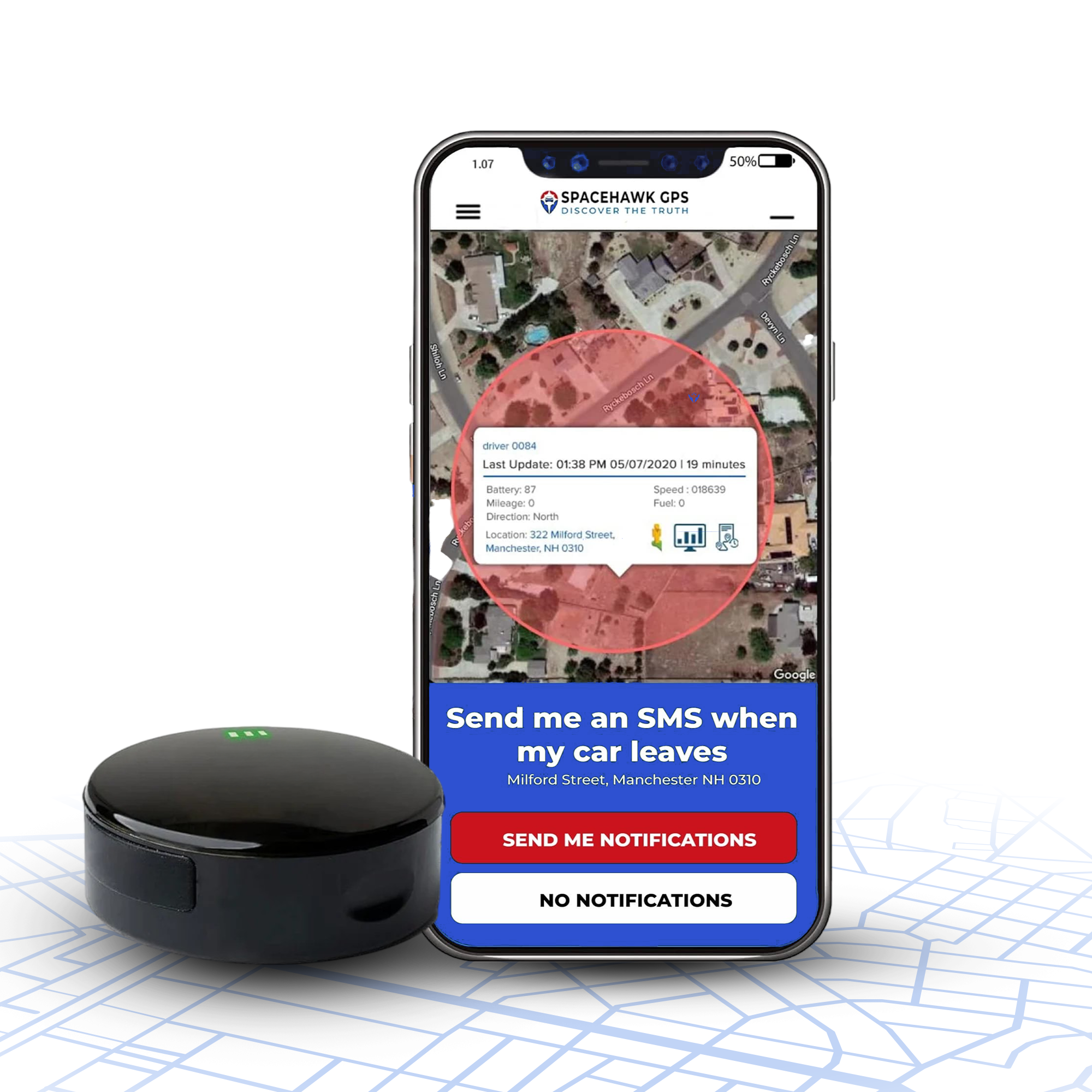
Two device types cover nearly every real-world case, and both report back to a phone app where a parent can view live location, trip history, speed alerts, and geofence notifications if the car leaves an approved area.
OBD2 plug-in trackers

These connect directly to the diagnostic port under the dashboard, usually on the driver's side below the steering wheel. Because they pull power straight from the car's electrical system, they don't run on a battery that needs charging, and many update their location every few seconds rather than every few minutes. That update frequency is what gives parents a genuinely current picture instead of a stale one.
If you're unsure which model to choose, see our guide to the Best OBD2 GPS Trackers for a detailed comparison of features, installation, and real-world performance.
Magnetic GPS trackers

These are small, battery-powered units housed in a magnetic case that attaches to the underside of a car or inside a wheel well. No wiring, no port, no professional install. That also means they're easy to move to a different vehicle or easy to overlook if you're not specifically checking for one.
If you're comparing battery-powered options, our guide to the Best Portable GPS Trackers covers the top magnetic trackers based on battery life, tracking accuracy, durability, and real-world performance.
Signs There Might Be a Tracker in Your Car

If you suspect a device is somewhere in your car, these are the places worth checking first.
- Under the dashboard near the steering column, where an OBD2 port lives on nearly every car built after the mid-1990s
- Underneath the vehicle, especially around the wheel wells, where a magnetic case can sit flush against metal
- Inside the trunk, the glovebox, or the spare tyre well, are common hiding spots for a small battery-powered unit
- Any wiring that looks newly added, spliced, or that doesn't match the rest of the factory harness
Behavioural clues count just as much as physical ones. If a parent suddenly stops asking where you've been, or mentions a location you never told them about, that's often a sign they already have the answer through a tracker rather than a conversation.
Common Misunderstandings About Car Tracking

"If I'm 18, they legally can't track me anymore": Not accurate on its own. Age counts for far less than who owns the vehicle. An 18-year-old driving a car titled to a parent is in a very different legal position than an 18-year-old driving a car titled in their own name.
"Removing the tracker solves the problem": Removing a device from a car you don't own can create its own legal and financial complications, since both the car and the tracker likely belong to someone else. It also tends to escalate trust issues rather than resolve them.
"Tracking only happens if they don't trust me": Not necessarily. A lot of tracking decisions get made before there's any reason for distrust at all, simply because the statistics around new teen drivers are what they are. It's frequently proactive, not reactive.
"A tracker means constant monitoring every second": In practice, most parents check the app occasionally rather than watching a live map all day. Geofence alerts and speed notifications do most of the actual work, only pulling a parent's attention when something outside the normal pattern happens.
How to Talk to Your Parents About Being Tracked

If tracking feels like too much, pulling the device out is rarely the move that actually improves things. It tends to shift the conversation from "let's talk about trust" to "why did you remove safety equipment from the car," which is a harder position to argue from. A better approach usually looks like this.
- Ask directly whether they're tracking the car and why, rather than assuming
- Propose a middle ground, like check-ins on longer trips instead of constant location sharing
- Bring your own safe driving record into the conversation if you have one to point to
- Suggest a specific review point, such as revisiting the topic after six months of clean driving
Most parents will loosen the reins once they see a consistent pattern of safe driving. Trust in this context builds exactly the way it does everywhere else in a relationship: slowly, and through evidence rather than argument.
Who This Matters Most For

New teen drivers in their first one to two years behind the wheel are the group parents watch most closely, since that window carries the highest statistical accident risk of any age group on the road. Many parents use a teen driving monitor to receive alerts for speeding, hard braking, and other driving behaviors during this learning period. If you're comparing monitoring options, see our guide to the Best Teen Driving Monitors to understand the features that can help improve safety and encourage responsible driving.
Families in states with a documented parent-guardian exception written into law face the simplest legal picture, since there's no ambiguity about consent. Teens whose car is titled in their own name, or who are already 18 and living independently but still driving a parent-owned vehicle, sit in the group where the legal nuance is sharpest, and where a direct conversation with parents is worth having early rather than after a dispute starts.
Final Thoughts
Most of the time, a parent tracking a teen's car comes from concern, not control, and the law backs that up in the large majority of states as long as the parent owns the vehicle. If you're on the receiving end of a tracker you didn't expect, a direct conversation almost always works better than trying to remove the device or simply ignore the situation. If you're the parent setting one up, telling your teen about it upfront, the way Scott did with Rachel, tends to build more long-term trust than letting them find out on their own.
This article is for informational purposes only and isn't legal advice. Laws vary by state and change over time, so confirm your local rules before installing or removing any tracking device.
About the Author

Frequently Asked Questions
Can my parents track my car without telling me?
Can my parents track my car if I'm 18?
What's the most common tracker parents use?
Can I legally remove a tracker from a car my parents own?
Does GPS tracking actually lower car insurance?
How do I know if the tracker is a magnetic unit or an OBD2 device?
- Choosing a selection results in a full page refresh.
- Opens in a new window.
 Buy on Amazon