
Ambulance Vehicle Management System

5 things to know about GPS tracking for ambulances
-
01
A tracker is not a dispatch system. Use it to see where units are. Not as a replacement for CAD.
-
02
Real-time GPS tracking routes the closest ambulance to emergencies instantly.
-
03
OBD2 plug-in GPS trackers require zero professional installation in ambulances.
-
04
Live GPS updates every 3 seconds keep dispatchers fully informed.
-
05
Crews are employees. Put the monitoring policy in writing before anything is fitted.
Ready to track your ambulance fleet?
Plug-in tracking for EMS fleets, fitted in seconds with no installer and no downtime.
Affiliate disclosure: This article contains Amazon affiliate links. As an Amazon Associate, GPS Tracker Shop LLC earns from qualifying purchases at no extra cost to you. Three of the five trackers here are also sold in our own store.
How we picked these
This comparison rests on published hardware specifications, manufacturer documentation, and the features that matter for EMS fleet use. Installation method, update frequency, coverage and subscription cost.
We sell three of the five. None of it comes from in-vehicle testing in an ambulance, and we say so rather than implying otherwise. Star ratings are left out entirely, because a rating we cannot stand behind is worse than none.

Our pick for an ambulance fleet
Konnect OBD2
This is a device we sell, so weigh the rest accordingly. The unit pushes into the OBD2 port every ambulance on a US chassis has carried since 1996. Fitting one takes about ten seconds and costs no downtime.
Updates run as fast as every three seconds, with a year of trip history. The plan is a flat $8.95 a month per vehicle.
Run a 911 service with computer-aided dispatch? Read the honest limit below before buying anything here.
When an emergency strikes, paramedics are the people we count on to arrive fast. Every second counts, and GPS tracking has become a standard part of how ambulance fleets manage that pressure.
With real-time tracking, dispatchers know where each ambulance is and can send the closest unit. Gone are the days of relying on radio updates alone.
6%
Each extra minute of EMS response time meant a 6 percent drop in cardiac arrest survival odds.
Damdin and colleagues, Archives of Academic Emergency Medicine, 2025. A five year study of 5,433 out-of-hospital cardiac arrest patients.
The honest limit, before you spend anything
A GPS tracker shows you where your vehicles are. That is not computer-aided dispatch, and not an AVL system integrated with your CAD.
If you run 911 response, the unit recommendation that reaches a crew still comes from your dispatch software. A tracker sits alongside that. The genuine value is fleet oversight, mileage, maintenance and route history.
Where these devices fit best is the work around the ambulances. Supervisor vehicles, support trucks, equipment trailers, and private or non-emergency transport fleets that have no CAD at all.

The 5 Best GPS Trackers For Ambulances Compared
| Tracker | Best for | Install | Running cost | Buy |
|---|---|---|---|---|

|
Ambulances with an OBD2 port | Plug in, no tools | $8.95 a month | Buy Now |

|
Vehicles with no usable port | Magnetic, no wiring | $19.95, or $9.95 prepaid | Buy Now |

|
Mixed fleets on one account | Magnetic, no wiring | Year one bundled, then a plan | Buy Now |

|
A portable unit and a good app | Case in the starter kit | From about $22.95 a month | Buy on Amazon |

|
Trailers and equipment | Magnet or hardwire | $9.95 annual, $19.95 monthly | Buy Now |
Konnect OBD2 - Best Overall For Ambulance Fleets

Our own pick for a fleet
For a fleet that wants to plug in and go, Konnect is hard to beat. The unit fits the OBD2 port, skips professional installation entirely, and starts reporting once connected.
Updates run as fast as every three seconds. You also get a full year of trip history, plus geofence and speed alerts. Fitting a vehicle costs no shop time and no downtime. On an ambulance that matters more than it does on a van.
Two limits worth stating. The unit reports location and speed rather than a driver behavior score. The port also has to be free. That rules out any vehicle already running an ELD or a telematics box.
The right answer for most ambulance fleets. Not the answer if the port is taken, or the asset has no port at all.
View Key Features
- Location updates as fast as every three seconds
- Plug-and-play OBD2 install, no wiring and no installer
- A full year of historical trip data
- Geofence and speed alerts
- Flat $8.95 a month per vehicle, no contract
View Pros & Cons
Pros
- No install, no downtime
- Three second updates
- Cheapest plan here
- A year of trip history
Cons
- Needs a free OBD2 port
- No driver behavior score
- Visible in the cab
SpaceHawk GPS - Best For Vehicles Without A Free Port

Also ours, and the answer when the port is taken
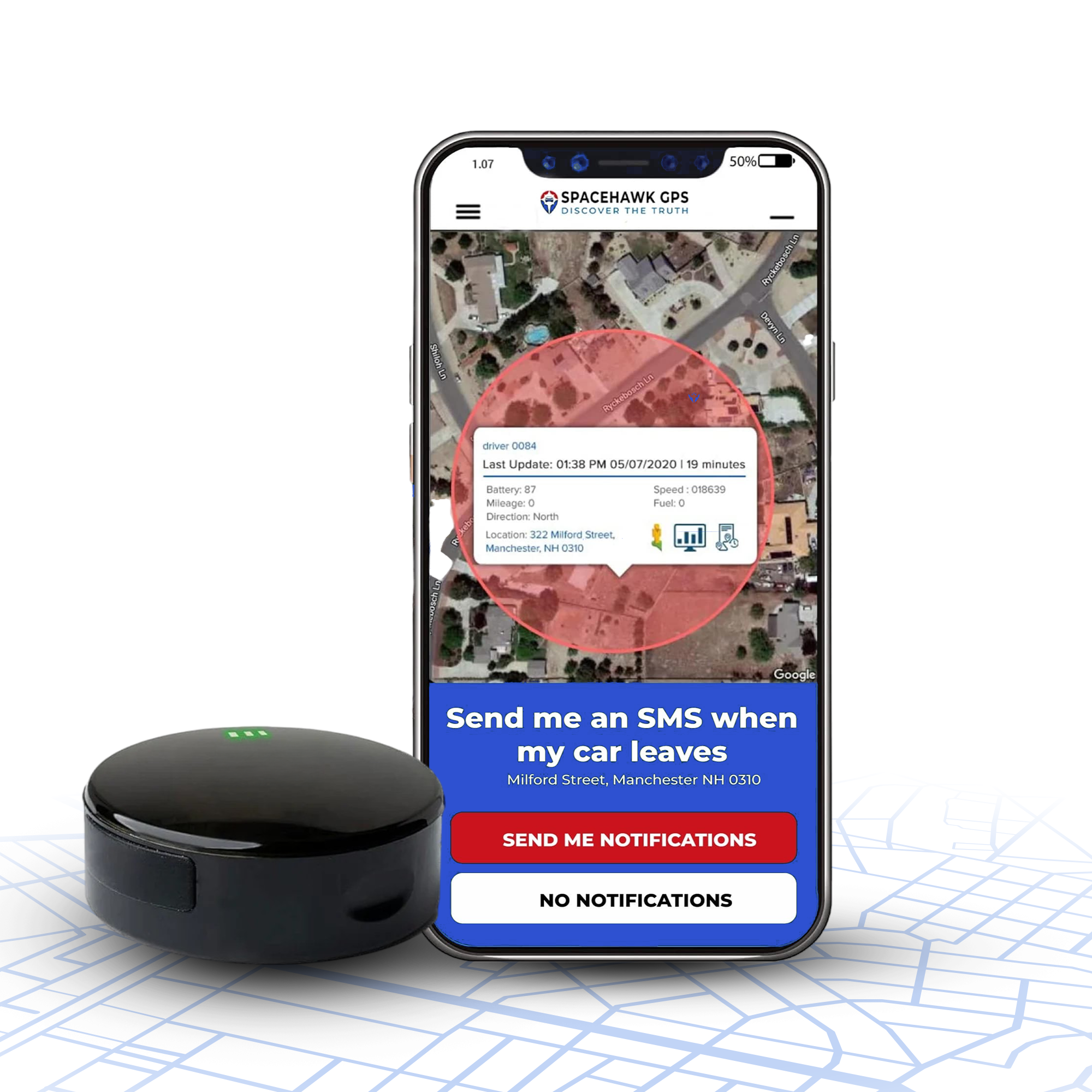
Plenty of ambulances already have something in the diagnostic port. SpaceHawk sidesteps that entirely with a magnetic waterproof housing that clamps to a frame rail in seconds.
Updates land every three seconds and accuracy sits around six feet, with a year of trip history behind it. Nothing ties it to a port. One unit can move between a spare rig and a supervisor vehicle as the roster changes.
The trade against Konnect is power. This unit runs on its own battery. Recharging comes round every one to three weeks, depending on the interval.
Buy it for vehicles Konnect cannot fit. Lifetime warranty and US based support come with it.
View Key Features
- Magnetic mount, no wiring and no port needed
- Waterproof housing for outside mounting
- Updates as fast as every three seconds, accuracy around six feet
- One to three weeks of battery, depending on the interval
- Lifetime warranty with US based support
View Pros & Cons
Pros
- No port required
- Moves between vehicles
- Waterproof housing
- Lifetime warranty
Cons
- Needs recharging
- Dearer plan than Konnect
- No engine diagnostics
8 minutes
Responses inside eight minutes were associated with roughly double the odds of surviving to hospital discharge, against slower ones.
Same 2025 study. Dispatch accuracy is one factor among several that shape a response time.
LandAirSea 54 - Best Multi-Vehicle Fleet Value

Best for a mixed fleet
Agencies managing more than the ambulances themselves tend to land here. Supervisor cars, support trucks and spare rigs all sit under one account. The magnetic mount goes on in seconds.
Sealing is genuine at IP67 and reporting is motion activated. That stretches a charge to roughly seven to fourteen days in daily service.
One number needs care when you compare. The three second update rate belongs to the premium SilverCloud tier, not the entry plan. Name the tier when you price it against anything else.
Good value across a mixed fleet. Every vehicle you add needs its own subscription.
What "no monthly fee for the first year" means
A tracker reporting every few seconds is sending cellular data, and cellular data is never free. In this category the phrase almost always means one thing. The first year of service is prepaid inside the purchase price.
That is true of the bundle we sell. Year one is covered, and after that the plan is a live cost like any other. Ask any seller what year two costs, ours included. Compare on a three year total rather than a sticker price.
View Key Features
- Twelve months of service bundled into the purchase price
- IP67 sealed, with a strong internal magnet
- Seven to fourteen days on motion activated reporting
- Multiple vehicles managed from one account
- Update rate varies by plan tier
View Pros & Cons
Pros
- Year one is bundled
- One account, many vehicles
- Genuinely IP67 sealed
Cons
- A plan per vehicle
- Fast rate costs more
- No engine diagnostics
Spytec GL300 - Best For A Portable Unit And A Good App

Best app on this page
Worth knowing before you compare listings: the Spytec Atlas and the GL300 are the same product. Atlas is the marketing name, GL300 is the model number, and purchasing departments regularly price them as two things.
Battery runs up to fourteen days and updates go as fast as every five seconds. The app is the most polished here. The starter kit includes a weatherproof magnetic case.
Sealing is the weak point and it is worth being blunt. The unit itself is IPX5, covering rain and spray but not submersion. That makes it the least sealed device here.
Strong software, weakest weather rating. Keep it inside the cab rather than under the chassis.
View Key Features
- Up to fourteen days of battery per charge
- Updates as fast as every five seconds
- Weatherproof magnetic case included in the starter kit
- IPX5 rated, so rain and spray rather than immersion
- Falls back to cellular and Wi-Fi positioning indoors
View Pros & Cons
Pros
- Best app on the list
- Five second updates
- Case in the starter kit
Cons
- IPX5, not submersible
- Dearest plan here
- We do not stock it
Outlaw Portable GPS - Best For EMS Equipment And Support Trailers

Ours, and the one for assets without a port
Not every asset worth tracking has an OBD2 port or a battery. Outlaw is made for the rest of it. Equipment trailers, mobile command units and gear caches that sit unpowered for months.
The battery is the reason to pick it, and the numbers deserve explaining. Reporting every three minutes while an asset is moving gives about 120 hours of motion. In energy saver mode at one report a day, the same cell runs about two and a half years.
Those are not competing claims. One counts hours of movement and the other counts calendar time on a trailer that mostly sits still.
The right tool for unpowered equipment. Coverage runs to 155 countries and the warranty is lifetime.
View Key Features
- 4240 mAh cell, 2.8 by 2.8 by 1 inch, 9.6 oz
- IP67 sealed, with a built in magnet or a hardwire option
- Updates as fast as every three seconds
- Motion activated sleep, and coverage across 155 countries
- Made in the USA, SIM included, lifetime warranty
View Pros & Cons
Pros
- Years in saver mode
- Magnet or hardwire
- IP67 and rugged
- Lifetime warranty
Cons
- Dearest device here
- Not an in-cab install
- Fast pings drain it
Benefits Of GPS Tracking For Ambulances
Most of the value in an EMS fleet is unglamorous. Knowing which unit is closest matters. So does knowing which rig is due for service before it strands a crew.
Faster dispatch decisions
Real-time location lets a dispatcher send the closest available unit rather than the one that answered the radio first.
Lower fuel and maintenance cost
Mileage and idle data flag service intervals early. A rig then comes off the road on your terms, not on a call.
Equipment accountability
Trailers and gear caches carrying medical equipment can be tracked separately from the ambulances themselves.
Historical route records
Pull up a past route to answer a question weeks later, rather than reconstructing it from memory.
Mutual aid coordination
When units cross into a neighboring district, a shared map shows where everyone actually is.
Insurance and claims
A recorded route settles a disputed incident quickly, which is worth real money on a fleet of any size.
Tell Your Crews Before You Fit Anything
Paramedics are employees, and the rules follow from that
Tracking a vehicle your service owns is lawful, and the reason is ownership. What decides trouble later is notice, not technology.
- Put it in writing. A short signed policy naming what is tracked, when, and who sees it settles most disputes before they start.
- Service vehicles only. A tracker on a crew member's own car is a different question and a much harder one.
- Stop at the end of the shift. Round the clock monitoring of a take-home vehicle is where most complaints come from.
- Check your state. Requirements vary, and New Jersey's notice law currently reaches furthest.
- Bring the union in early if your crews are represented. Monitoring is usually a bargaining subject, and a policy agreed in advance is cheaper than a grievance.
Crews who were told tend to accept it within a week. Crews who find out on their own rarely do.
How GPS Tracking Improves Safety For Ambulance Transport
Dispatchers need a clear view of where each ambulance is and which one can reach a call fastest. GPS tracking helps that decision with better information than a radio check alone provides.
What the research actually shows
The strongest evidence linking response time to outcomes comes from cardiac arrest research specifically. Broader claims about saving lives across all call types are much harder to support.
A 2025 retrospective study of 5,433 patients found a clear pattern. Each extra minute of response time meant roughly a 6 percent drop in the odds of surviving to discharge. Responses inside eight minutes roughly doubled those odds.
Damdin and colleagues, Archives of Academic Emergency Medicine, 2025, volume 13, issue 1. Faster dispatch is one factor among several shaping a response time. A tracker supports it rather than delivering it.
Fitting a fleet this quarter?
Konnect plugs in per vehicle in about ten seconds, with no installer and no downtime.
Buy Now
A note on family tracking
Some EMS agencies and hospital systems offer a feature letting a patient's family follow a transport in real time. That is a service the agency builds, not something any tracker on this page provides on its own.
Where it exists it is opt-in and set up per transport. A family member cannot activate it, and an ambulance's location is not broadcast publicly or by default.
A tracker tells you where the rig is. Your dispatch software still decides who goes.
Ryan Horban
Not sure which of these fits your service
Tell us how many vehicles you run, whether the OBD2 ports are free, and if you have CAD. We will tell you what fits, including when the answer is not a device we sell.
Talk to usSources: Damdin S, Trakulsrichai S, Yuksen C and colleagues on EMS response time and survival after out-of-hospital cardiac arrest. Archives of Academic Emergency Medicine, 2025, volume 13, issue 1. Manufacturer specifications and current published pricing for each product named.
Frequently Asked Questions
How Can GPS Tracking Improve Ambulance Response Times?
Dispatchers get accurate real-time locations, so they can route the closest available unit rather than relying on radio check-ins.
Research on out-of-hospital cardiac arrest links each extra minute of response time to a measurable drop in survival. Faster dispatch is one factor that can shorten that window.
Does GPS Tracking Work With Existing EMS Dispatch Software?
Sometimes, and this is the question to settle before you buy. Most fleet platforms support data export, but integration with a specific computer-aided dispatch system varies by vendor.
If a live CAD feed is a requirement, confirm it with the tracker provider and your dispatch vendor first. None of the consumer devices on this page ships with CAD integration out of the box.
Who Can Access Ambulance GPS Location Data?
The agency that owns the account controls access, which normally means fleet managers and dispatch staff. Location data is not public by default.
Set the access list deliberately rather than by accident, and write it into the monitoring policy your crews sign.
Can GPS Tracking Be Used For Other Emergency Vehicles Besides Ambulances?
Yes. Fire apparatus, police vehicles, supervisor cars and support trucks all use the same tracking. The same notice rules apply to those crews.
Will An OBD2 Tracker Affect An Ambulance Warranty Or Its Equipment?
A plug-in tracker reads the diagnostic port rather than altering the vehicle, and it removes without a trace. Even so, an ambulance is a heavily upfitted vehicle.
Check with your upfitter or fleet maintenance before standardizing across the fleet. Especially if the port already holds an ELD or a telematics box.
- Choosing a selection results in a full page refresh.
- Opens in a new window.
 Buy on Amazon